B1 Runs on the network you already have
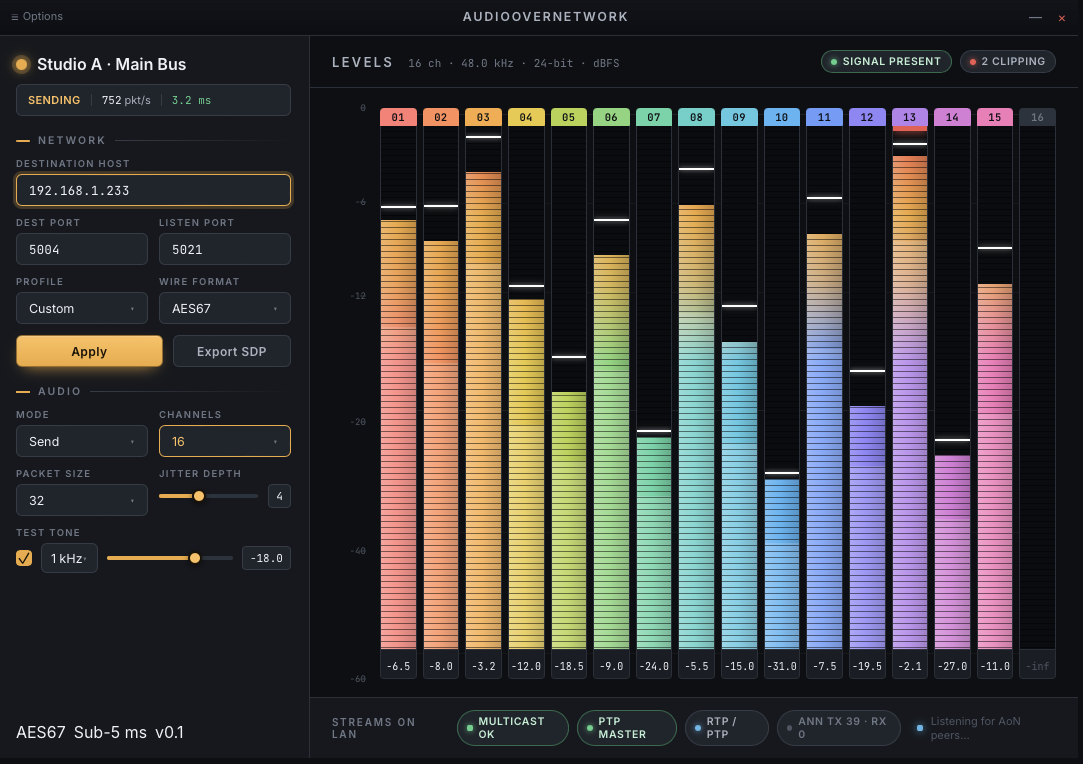
No proprietary NIC, switch, or dongle. Wired gigabit gives the best latency and lets you use larger packets; Wi-Fi works for monitoring and lower channel counts.
B2 Tunable latency vs. robustness
Packet size and jitter-buffer depth trade latency against resilience — dial in anything from a sub-5 ms wired snake to a deep-buffered Wi-Fi monitor feed.
B3 Glitch-free long runs
The receive-side adaptive resampler slaves the output clock to the incoming stream, eliminating the slow buffer drift and periodic dropouts you'd get from two free-running interface clocks — no shared word clock needed.
B4 Real-time-safe audio engine
The audio thread never blocks or allocates: a lock-free jitter buffer and pre-allocated buffers keep the processing path wait-free, avoiding the priority-inversion dropouts common in naive network-audio code.
B5 Standards interoperability
Native AES67 / ST 2110-30 (L24 RTP), NMOS IS-04 discovery and IS-05 connection management, PTPv2 sync, and SDP transport files mean it fits professional broadcast and AV-over-IP ecosystems — not just its own.
B6 Sequence-accurate, ordered delivery
Packets are reordered by sequence number, late and duplicate packets are handled, and missing audio is concealed — with a hard latency cap that prevents runaway buffering if a clock mismatch develops.
B7 Resilient discovery
Three independent paths — Bonjour, UDP multicast, and a same-host file registry — mean peers still find each other when one path is blocked, plus manual IP always works.
B8 Flexible channel & bus handling
Up to 16 discrete channels independent of the host's bus layout, and an engine that runs send-only or receive-only — so a receive-only machine needs no input device and a send-only machine needs no output.
B9 Self-contained and inspectable
Built in portable C++ — no cloud service, no account, no subscription. The audio stays on your local network.