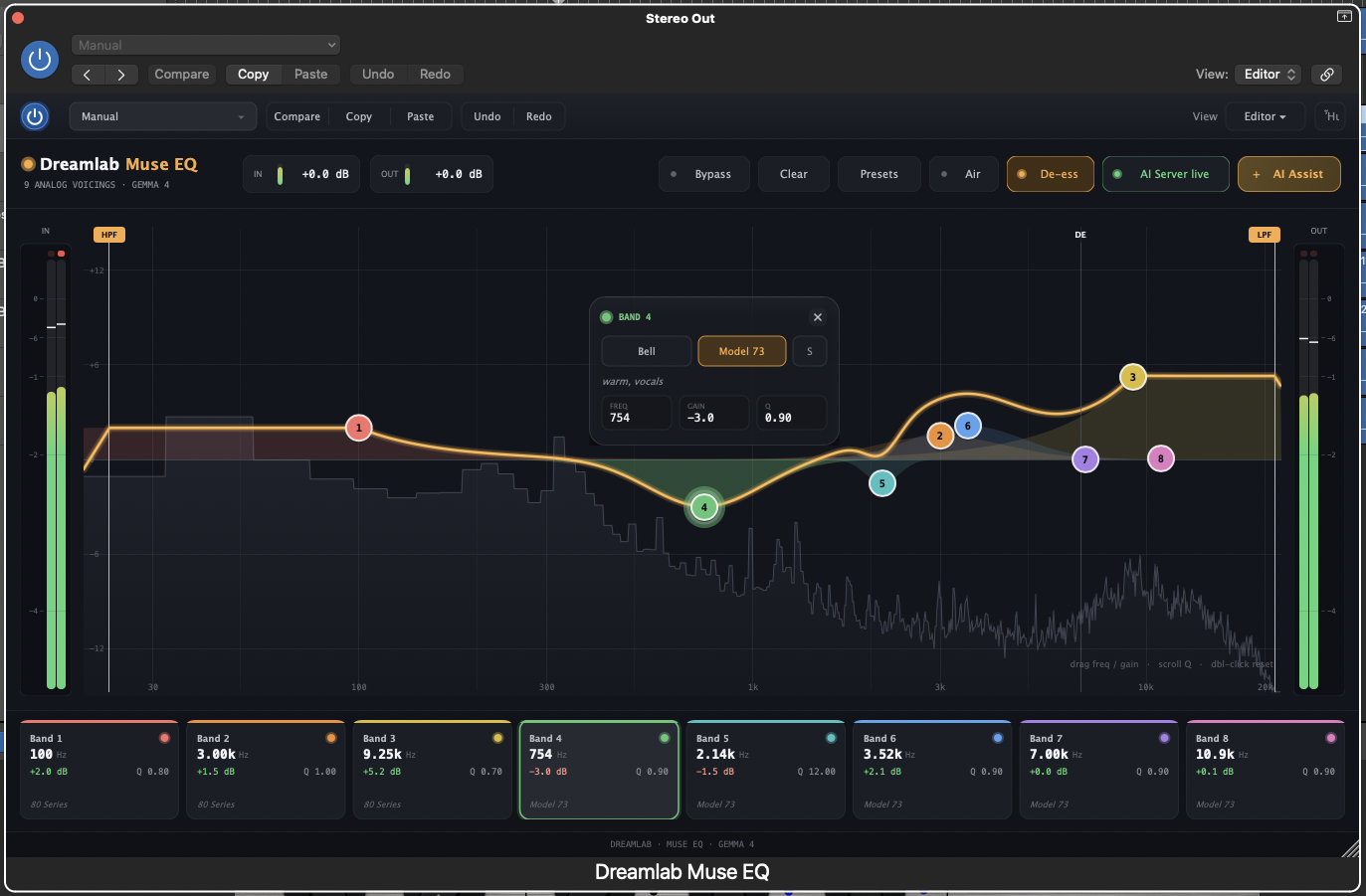
Each of the eight bands can use its own voicing. Every voicing reshapes the underlying biquad
coefficients — these are not EQ presets, they are different filter shapes. Reach for the flavor
that actually fits the move.
Classic
Model 73
The Class A, transformer-coupled 1970 voice with custom-wound input and output transformers — meaty low-end, silky high-frequency bloom, and rich harmonic saturation that adds body to vocals, drums, and electric instruments.
Classic
Model 81
The faster, tighter 1972 sibling of the same module family — discrete Class A/B, still transformer-coupled but noticeably more modern and controlled. A staple for drums, bass, and guitars.
Classic
Model 84
A Class A 1970s module with a different transformer winding — a subtly different harmonic distribution from the other modules in the family, plus a high-Q mid switch for surgical work with the same Class A timbre.
Classic
80 Series
The channel strip from the big-iron 1970s console — same Class A DNA as the module family, but with larger transformer character that gives it airier top end and the wider bus glue of the console voice.
Classic
Passive EQ
A passive two-band tube program EQ where harmonic character comes from the tube makeup amplifier, not a transformer — broad musical curves and distinctly different from everything else in the library. Implements the classic boost-and-cut trick: boost and cut at the same frequency and the band widens and shifts exactly the way the real hardware does.
Classic
4K-E
Deliberately not transformer-coupled — solid-state and VCA-based, with the punchy, aggressive, in-your-face midrange that defined eighties pop and rock records. Especially drums and master bus.
Classic
Q EQ
The defining Proportional-Q behavior: bandwidth narrows as gain increases. Small moves stay broad and musical at Q ≈ 0.3–0.5; large moves tighten into punch at Q ≈ 1.5–2.5 — the single most important sonic fingerprint of the original.
Classic
Range A
Inductor-based rather than capacitor-based — which is what produces its sweet, musical character and signature high-end "bloom." Not a simple boost but an extended, musical shimmer — the reason inductor EQs stayed in front of vocals right through the analogue era.
Digital
Clean
No transformer, no tube, no inductor, no saturation — bit-exact pass-through when gain is zero. For surgical cuts on muddy resonances, precise de-essing, or reference mixing where any coloration would be wrong.