Vallaren DTR-48 GET LUFS MASTER
VALLAREN / PLUG-INS / LUFS Master
Loudness Meter · True-Peak Limiter · ITU-R BS.1770-4 · AU / VST3

Master to the number the platform reads.

LUFS Master is the last plugin on your stereo bus. It measures loudness exactly the way Spotify, Apple, YouTube, and broadcast networks do — ITU-R BS.1770-4 — shows you the health of your stereo image, and holds your output to a true-peak ceiling so you never deliver a file that clips. One window answers the three questions every master must pass: is it the right loudness, is it safe on playback, and will it hold together everywhere people listen.

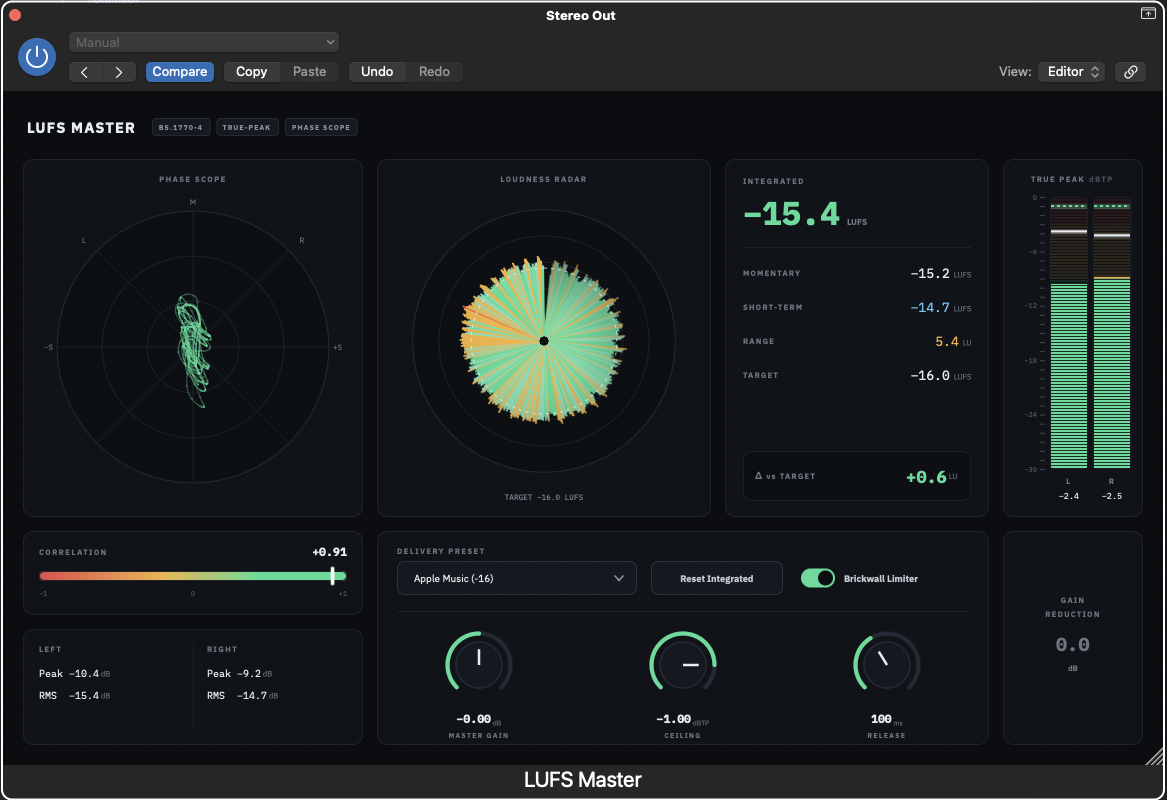
DreamLab LUFS Master interface — a goniometer phase scope and correlation meter on the left, a circular loudness radar in the center, momentary / short-term / integrated / loudness-range / target / delta-vs-target readouts, true-peak dBTP bar meters, an Apple Music (−16) delivery preset, and Master Gain / Ceiling / Release knobs with a brickwall limiter.
StandardITU-R BS.1770-4
MetersM · S · I · LRA
LimiterTrue-peak brickwall
ScopeGoniometer + correlation
Presets9 delivery targets
FormatsAU · VST3 · Standalone
01 / What it shows

Loudness, four ways — plus the why behind the numbers.

The center of the plugin reports loudness the way the delivery world measures it. Around it sit the tools that tell you why the numbers look the way they do — a sweeping loudness radar, a live goniometer, and a correlation meter.

Momentary
−13.7LUFS

The last fraction of a second — loudness moving in real time.

Short-term
−13.7LUFS

A three-second window — the feel of the current passage.

Integrated
−15.8LUFS

The gated average over the whole program — your true delivery loudness.

Loudness Range
8.0LU

How dynamic the material is, quietest meaningful passage to loudest.

01·a

Loudness radar

A circular display sweeps your recent loudness history and color-codes every moment against your target, so consistency problems — a chorus that jumps, a verse that sags — jump out at a glance instead of hiding in a number.

Sweeping history · target-relative color
01·b

Goniometer & correlation meter

A phase scope draws the stereo field as a live Lissajous figure with dB rings, while a correlation meter warns you when parts of the mix are out of phase and will collapse in mono. The mistakes loudness numbers can't see — a widened mix that disappears on a phone, a balance drifted to one side — surface here.

Lissajous phase scope · mono-compatibility warning
01·c

Peak, RMS & true-peak bars

High-precision Peak and RMS readouts per channel, plus true-peak (dBTP) bar meters with a numbered scale and peak-hold, round out the picture — the level detail that sits underneath the loudness story.

Per-channel peak/RMS · dBTP bars · peak-hold
02 / Why it matters

Peak level and loudness are two different problems.

F.01

The number in the plugin is the number the platform reads

The loudness engine implements ITU-R BS.1770-4 — the same algorithm Spotify, Apple, YouTube, Netflix, and broadcast networks use to decide how loud your audio is. Read it here and you know exactly what the delivery platform will read, before you ever upload.

BS.1770-4 · standards-accurate · not "by feel"
F.02

Every streaming service normalizes you anyway — so know your number

Spotify, Apple Music, YouTube, and Tidal all turn your track up or down to land near their own target (roughly −14 LUFS). Master too loud and the platform turns you down, throwing away the dynamic range you crushed to get there. Knowing your integrated loudness lets you make that call deliberately, not by accident.

Playback normalization · preserve dynamics
F.03

True-peak limiting catches what a sample meter misses

When digital audio is converted back to analog, the reconstructed waveform can rise higher than any individual sample — an inter-sample peak. A file that looks clean on a normal meter can still distort on a phone or a lossy stream. LUFS Master oversamples to catch those peaks and holds output to a true-peak ceiling, so what you deliver is genuinely safe on real playback systems.

Oversampled detection · inter-sample-peak safe · dBTP ceiling
F.04

In broadcast, the target is contractual

Television delivery specs — −24 LUFS in the US under ATSC A/85, −23 LUFS under EBU R128 in Europe — are enforced. A program delivered off-spec gets rejected. There, an accurate BS.1770 meter with a true-peak limiter isn't a preference, it's the tool the spec assumes you're using.

ATSC A/85 · EBU R128 · deliverable, not preference
03 / The workflow

Guesswork becomes a short, repeatable routine.

Because gain in dB maps almost one-to-one onto LUFS, the correction is immediate and predictable. Four steps, and you're in spec.

01
Pick the preset

Choose where the audio is going — streaming, podcast, game, broadcast. It sets both the loudness target and the recommended true-peak ceiling.

02
Mix into the meters

Let the program play. The integrated reading settles on your true delivery loudness over the whole piece.

03
Read Delta vs Target

One value, in plain LU, tells you how far over or under you are. No mental math.

04
Trim & deliver

Move the master gain by that amount, arm the true-peak limiter at the preset ceiling, and you're in spec — safe and on target.

04 / Delivery targets

Nine presets. One picks your spec.

Each preset sets the loudness target and the recommended true-peak ceiling for its medium — so the right numbers are one click away.

Delivery targetLoudnessTrue-peak ceiling
Spotify / Tidal / YouTube−14 LUFS−1 dBTP
Apple Music−16 LUFS−1 dBTP
Podcast (Apple)−16 LUFS−1 dBTP
Gaming−16 LUFS−1 dBTP
TV Broadcast — US ATSC A/85−24 LUFS−2 dBTP
TV Broadcast — EU EBU R128−23 LUFS−1 dBTP
Club / EDM−9 LUFS−1 dBTP
Loud music master−7 LUFS−1 dBTP
Dynamic / acoustic master−13 LUFS−1 dBTP

A note worth keeping in mind: for streaming music specifically, the exact target matters less than people fear — the service normalizes playback anyway, so the smarter goal is to preserve dynamic range and land in the right neighborhood. The strict, non-negotiable targets are the broadcast ones — and that's exactly where an accurate, standards-based meter earns its place.

05 / Who it's for

One window for everyone who has to hit a number.

Mastering

Mixing & mastering engineers

The core users — anyone handing off a finished stereo file that has to meet a number. Replaces juggling several separate meters with one accurate, standards-based window.

Self-release

Musicians & producers

Takes the mystery out of "how loud should my song be?" and stops you over-compressing a master the platform is just going to turn down anyway.

Spoken word

Podcasters & audiobook producers

Live and die by the −16 LUFS target. The integrated reading plus Delta-vs-target makes hitting it trivial — and keeps loudness consistent across episodes.

Broadcast

Film, TV & post engineers

The users for whom this isn't optional. Delivery specs are contractual and enforced; an accurate BS.1770 meter with a true-peak limiter is exactly what the spec assumes.

Interactive

Game audio & content creators

Mixing to the −16 LUFS convention, or posting to YouTube and TikTok — the same quick target-and-trim workflow lands you where the platform expects.

Diagnostics

Anyone checking stereo health

A real-time phase scope and correlation meter for checking mono compatibility, spotting phase cancellation, or confirming a widened mix still holds together — even when loudness isn't the concern.

06 / At a glance

The short version.

BS.1770-4
ITU-R loudness standard
4
Loudness meters · M · S · I · LRA
9
One-click delivery presets
dBTP
True-peak brickwall limiter
±0.1 LU
Delta-vs-target precision
2
Scopes · goniometer + correlation
A/B
Compare · copy / paste settings
AU
VST3 · Standalone · macOS
Audio Unit (AU)
VST3
Standalone
Universal (arm64 + x86_64)
macOS 10.13+
07 / More from DreamLab

The rest of the rack.

Dynamics

Multiband

Phase-coherent 4-band mastering compressor with interactive spectrum and A/B peak-hold.

Equalizer

Muse EQ

AI-assisted equalizer · 9 analog voicings per band · Gemma 4 local inference.

Synthesizer

DDM S1

64-voice hybrid subtractive + 6-op FM polysynth with 8 algorithms.

Reverb

Convolution Reverb

Multi-engine reverb: a true-stereo convolver plus six algorithms, with shimmer, freeze, duck, and delay-into-reverb.

Saturation

SAT 456

Physically-modeled tape saturation — harmonic warmth, transient punch, smooth top end, and wow/flutter motion from a single insert.

Synthesizer

Synth CH388

Six-voice virtual analogue polysynth — rock-stable oscillator, creamy four-pole filter, and a two-mode stereo chorus. Zero latency, one panel.

Spatializer

Binaural Panner

3D placement panner with crosstalk cancellation. Works on headphones and real stereo monitors.

Restoration

Adaptive Noise Reducer

Real-time spectral suppression + envelope gate. Dual-stage attenuation with live activity meters.

Networking · free

AudioOverNetwork

AES67 / ST 2110 audio-over-IP between DAWs. Sub-5 ms on gigabit. MIT-licensed, open source.

Spectral filter

Sound Morph

Morphing spectral filter · 5 anchor shapes · dual-LFO motion · studio shimmer.

Modulation

D Chorus

Stereo BBD chorus and pitch shifter. Wide, warm, and wild. AU · VST3.

Modulation

DuoPhase

Dual 6-stage optical phaser with two sweep generators. Deep series swirls or wide parallel stereo motion.

Synthesizer

Vorion

Three oscillators, eight voices, and a modulation matrix built for trouble.

Overdrive

ScreamDriver

Circuit-modelled three-stage overdrive with tube-style compression, tape saturation, BBD chorus, pitch-bending echo, spring tank and a zero-latency cabinet loader.

Granular atmosphere

Lush

A granular atmosphere engine — Drone, Reverse, Shimmer and Gliss modes, pitch-tracked grains, and a Freeze that holds a cloud indefinitely.

Rhythm composer

DreamLab Drum Machine

Sixteen voices on a step sequencer that works the way the originals did — per-voice tune, decay and filter, accent per step, and producer-style swing.

Neural amplifier

Zelos

Neural amp capture and playback. Load a model or capture your own rig. Free · public beta.

Lo-fi

DreamLab Lo-Fi

Seven lo-fi modules on one panel — saturation, wow and flutter, bit crush, band limiting, dropouts, ambience and a ducked noise bed, under one Amount macro.

Delay

DreamLab Delay

Stereo analog echo and ducking delay — tape and lo-fi character, repeat filtering, ping-pong, and program-dependent ducking.

Currently viewing

LUFS Master

BS.1770-4 loudness metering, phase scope, and a true-peak brickwall limiter. AU · VST3 · Standalone.

Pitch

Pitch Corrector

Real-time pitch correction — natural intonation to hard-tune, with formant preservation. AU · VST3 · Standalone.

Drum trigger

Drum Trigger

Audio transient to MIDI generator. Tighten drums without losing groove. AU · Standalone.

Companion tool

Impulse Lab

Build your own impulse responses — design a space or capture a real one, deconvolve, and load it straight into Verb.

MIDI generator · free

Vibe Generator

A MIDI plug-in that writes full ambient, neo-soul and lo-fi songs across five parts. Free · public beta.

FORMATS
AU · VST3
ARCHITECTURE
Universal — Apple Silicon and IntelAPPLE M-SERIES RECOMMENDED
SECURITY
Signed and notarised by Apple
REQUIRES
macOS 10.13

LUFS Master is an original Dreamlab Digital Media product. It is not affiliated with, endorsed by, or derived from any hardware or software manufacturer. Full licence terms at dreamlabnet.com/daw2/eula.html.