Vorion is an analogue-modelled synthesizer that plays as a snarling monosynth or an eight-voice poly, with a modulation matrix built for trouble.
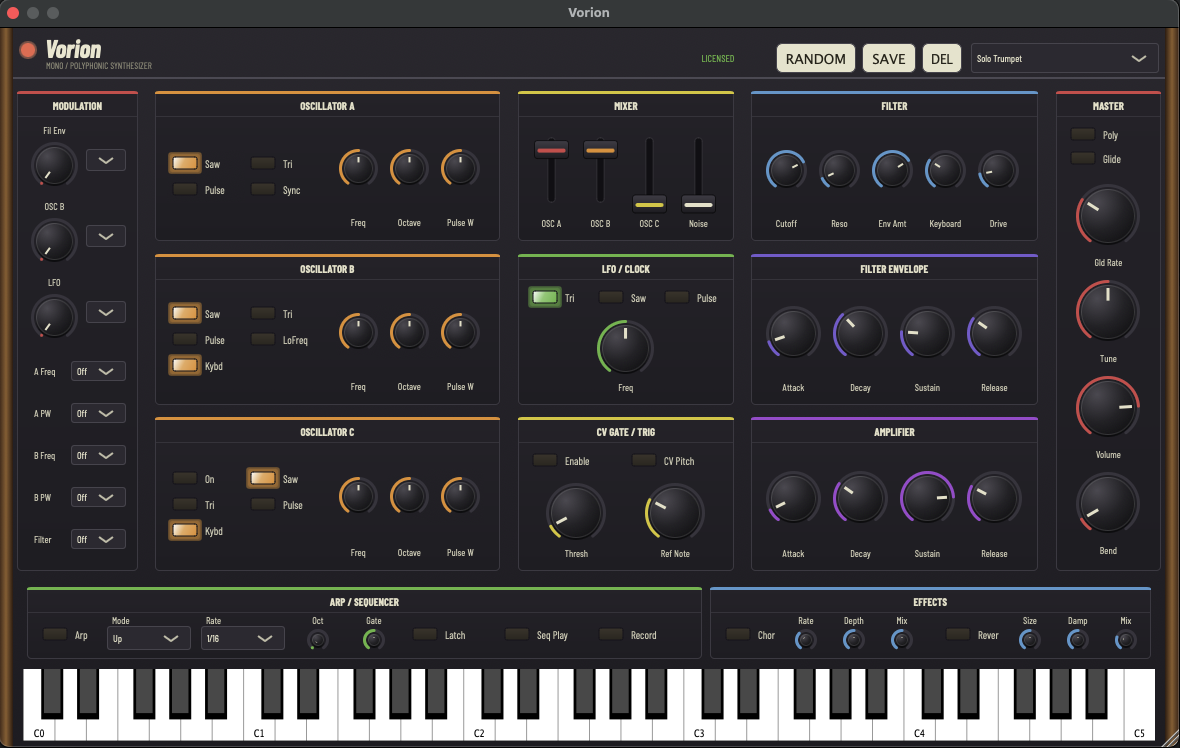
Each oscillator puts out saw, triangle and variable-width pulse at the same time — mix them however you like rather than choosing one. Independent octave and fine tune on all three.
Takes hard sync from B, for the classic tearing sync lead.
Double duty: track the keyboard and it is a second voice; drop it to low frequency and it becomes another modulation source.
An octave down for authority, a fifth up for power, or detuned against the other two for a wall of analogue.
They drift against each other, slightly and continuously. Bounded, DC-blocked, and never quite still — which is the entire point.
Resonant four-pole lowpass, with keyboard tracking, envelope amount and drive.
Push the resonance and it crosses into full self-oscillation and becomes a sine source you play from the keys. Filter-as-oscillator patches work properly here, not as an approximation. The drive control adds input saturation before the ladder, so it growls rather than just getting louder.
Three sources — filter envelope, oscillator B, and the LFO — each routable through a wheel or direct bus, into five destinations: oscillator A and B pitch, oscillator A and B pulse width, and the filter cutoff.
Oscillator B runs at audio rate. Route it to pitch and you get true cross-modulation: clangorous bells, ring-mod textures, sci-fi wreckage. This small panel is responsible for most of the sounds nobody expects a subtractive synth to make.
Glide and auto-legato — the playing feel that makes basslines sit right, down to how held notes re-glide when you release on top.
Natural voice allocation and overlapping release tails. Three-oscillator pads, brass stabs, drifting analogue strings.
Rate division, octave range, gate length and latch.
The first note you record lands on whatever key you are holding.
Feed a gate or trigger from a modular rig into the plug-in's input bus and clock the envelopes from your hardware, with adjustable threshold, optional 1V/octave pitch, and a settable reference note.
Chorus and reverb are on board, each with their own mix, so a patch arrives finished rather than needing two more plug-ins behind it.
Solo Trumpet · FM Bells · Filter as Oscillator · Phunko Basso · Grunge Guitar · Bass Clav · Percussive Organ · Single-Engine Crop Duster · Sync · Pipe Organ Flute · Clarinet · Bass Synth Sustain · Pseudo Ring Mod Bells · Dynamo · Arpeggiating Fifths · Plucked String · E-Bass · Synth-Pop Lead · Synth-Pop Pad — and more, plus unlimited user presets saved from the panel.
There is a Random button too, for when you have run out of ideas or patience.
Flat, dark, colour-coded by section — orange for oscillators, blue for the filter, purple for envelopes, green for the arp and clock. Every control is on one screen; nothing is hidden behind a tab. A playable keyboard sits along the bottom, and the whole thing resizes.
Phase-coherent 4-band mastering compressor with interactive spectrum and A/B peak-hold.
AI-assisted equalizer · 9 analog voicings per band · Gemma 4 local inference.
64-voice hybrid subtractive + 6-op FM polysynth with 8 algorithms.
Multi-engine reverb: a true-stereo convolver plus six algorithms, with shimmer, freeze, duck, and delay-into-reverb.
Physically-modeled tape saturation — harmonic warmth, transient punch, smooth top end, and wow/flutter motion from a single insert.
Six-voice virtual analogue polysynth — rock-stable oscillator, creamy four-pole filter, and a two-mode stereo chorus.
3D placement panner with crosstalk cancellation. Works on headphones and real stereo monitors.
Real-time spectral suppression + envelope gate. Dual-stage attenuation with live activity meters.
AES67 / ST 2110 audio-over-IP between DAWs. Sub-5 ms on gigabit. MIT-licensed, open source.
Morphing spectral filter · 5 anchor shapes · dual-LFO motion · studio shimmer.
Stereo BBD chorus and pitch shifter. Wide, warm, and wild. AU · VST3.
BS.1770-4 loudness metering, phase scope, and a true-peak brickwall limiter. AU · VST3 · Standalone.
Real-time pitch correction — natural intonation to hard-tune, with formant preservation. AU · VST3 · Standalone.
Audio transient to MIDI generator. Tighten drums without losing groove. AU · Standalone.
Build your own impulse responses — design a space or capture a real one, deconvolve, and load it straight into Verb.
Dual 6-stage optical phaser with two sweep generators. Deep series swirls or wide parallel stereo motion.
Circuit-modelled three-stage overdrive with tube-style compression, tape saturation, BBD chorus, pitch-bending echo, spring tank and a zero-latency cabinet loader.
A granular atmosphere engine — Drone, Reverse, Shimmer and Gliss modes, pitch-tracked grains, and a Freeze that holds a cloud indefinitely.
Sixteen voices on a step sequencer that works the way the originals did — per-voice tune, decay and filter, accent per step, and producer-style swing.
Neural amp capture and playback. Load a model or capture your own rig. Free · public beta.
Seven lo-fi modules on one panel — saturation, wow and flutter, bit crush, band limiting, dropouts, ambience and a ducked noise bed, under one Amount macro.
Stereo analog echo and ducking delay — tape and lo-fi character, repeat filtering, ping-pong, and program-dependent ducking.
Three oscillators, eight voices, and a modulation matrix built for trouble.
A MIDI plug-in that writes full ambient, neo-soul and lo-fi songs across five parts. Free · public beta.
Three oscillators, eight voices, and a modulation matrix with bad intentions.
Vorion is an original Dreamlab Digital Media product. It is not affiliated with, endorsed by, or derived from any synthesizer manufacturer, and it does not model or emulate any specific third-party instrument. Full licence terms at dreamlabnet.com/daw2/eula.html.