Vallaren DTR-48 GET BINAURAL PANNER
VALLAREN / PLUG-INS / Binaural Panner
3D Psychoacoustic Spatializer · Stereo · HRTF

A 360° panner. Left, right, front, behind, above, below.

Instead of a balance knob that just makes a sound louder in one speaker, Binaural places your source in 3D space around the listener using MIT KEMAR head-related impulse responses. Tuned as a mix-spatialization tool — the goal is a stereo mix that feels more dimensional, not a strict VR renderer.

GET BINAURAL PANNER — $39
Version1.0
HRIR setMIT KEMAR
FormatsAU · VST3
Use onHeadphones · Stereo monitors
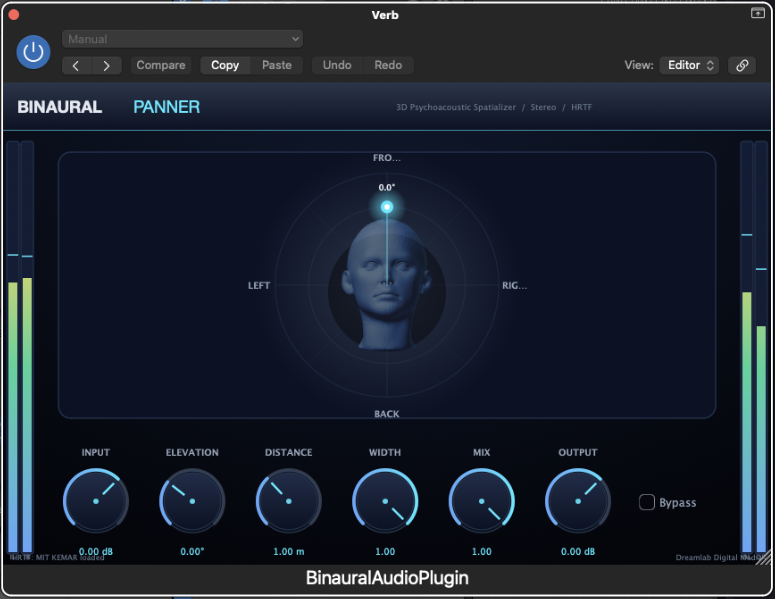
DreamLab Binaural Panner interface
01 / Two listening modes

Works on headphones and real speakers.

Most binaural plugins only work correctly on headphones. Binaural includes a Bauer / Atal-Schroeder crosstalk cancellation network — a feedback-based XTC structure — that pre-cancels the sound your left speaker would otherwise leak into your right ear (and vice versa), so the spatial cues survive being played through actual stereo monitors.

Headphones

Raw HRTF binaural

Straight HRTF-convolved output — each ear gets precisely the timing, level, and tonal shaping a real source at that location would produce. Correct on any pair of headphones.

Speakers · XTC

Crosstalk-cancelled for stereo monitors

Pre-cancels inter-channel leakage so the binaural cues land on the correct ear. Tuned to your monitor angle via Speaker Spread.

±15° Narrow
±20° Std
±30° Wide
02 / Features

Every layer tuned for mixing, not metrics.

F.01

HRTF convolution via MIT KEMAR

When sound hits a real human head, each ear gets slightly different timing, level, and tonal shaping depending on where the source is. The plugin sums the stereo input to mono, then convolves that mono signal through the pair of HRIRs (left-ear and right-ear) for the chosen position. The output stereo signal contains the same spatial cues your ears would get if a real source were in that location.

Industry-standard KEMAR dataset
F.02

Distance is more than a volume knob

As a source moves farther away, an air-absorption filter rolls off high frequencies the way real air does over distance. The early-reflections layer adjusts. Distance-driven gain compensation keeps things feeling real instead of just quiet — so moving a source from 1 m to 10 m actually sounds like walking away, not turning down.

Air absorption · ER shift · gain compensation
F.03

Room — believable early reflections

The Room dial mixes in two-tap stereo cross-routed early reflections — a quick sense of being in a space without a full reverb tail. It works in tandem with the panner so reflections seem to come from a believable direction.

F.04

Width — collapse or widen the binaural image

Collapse the binaural output toward mono for a tighter placement, or widen it for a more dramatic stereo feel. Especially useful for bus or master applications where you don't want any one element going extreme stereo.

F.05

Head view as direct manipulation

The head visualizer in the middle of the window doubles as a clickable / draggable target for azimuth and elevation. Touch where you want the sound — the dot follows, the HRIR pair loads, you hear it there.

Drag to place · throttled HRIR reload
F.06

Live stereo metering

Stereo input and output meters with peak-hold ticks are drawn on either side of the head view, identically sized for L and R — levels are never a guess.

03 / Controls

Seven dials across the bottom strip.

Front panel

Rotary controls · left to right
  • Input
    ±24 dB
  • AzimuthHead-view horizontal target
    −180° to +180°
  • ElevationHead-view vertical target
    −40° to +90°
  • DistanceDrives air absorption, ER, and gain comp
    0.1 – 10 m
  • WidthBinaural image spread
    0 – 2×
  • RoomTwo-tap cross-routed ER
    0 – 100 %
  • MixGlobal dry/wet
    0 – 100 %
  • Output
    ±24 dB
  • BypassClick-free host-respecting bypass
    on / off
Two title-bar pill buttons control listening mode (Headphones / Speakers) and — in Speakers mode — the assumed Speaker Spread (±15° / ±20° / ±30°). The spread pill is dimmed in Headphones mode because it has no audible effect there.
04 / Engineering

Real-time safe, session-aware.

RT-safe DSP

No audio-thread allocations

Scratch buffers are pre-allocated in prepareToPlay. The audio thread never touches the heap — zero GC-style stalls, no click or drop on automation.

Smoothing

Click-free parameter changes

Every parameter is smoothed at audio rate so manual moves and host automation land clean, without the zipper-noise you get from raw value jumps.

HRIR reload

Throttled by position delta

Automating azimuth or elevation doesn't crackle or drop out — HRIR pair reloads are gated by distance from the last-loaded position and cross-faded in the buffer.

XTC

Bauer / Atal-Schroeder feedback

Feedback-based crosstalk cancellation in Speakers mode. Tuned to three monitor geometries so the binaural cues survive playback on real stereo pairs.

Distance model

Physics-derived

Air absorption via a first-order LP tracking the inverse-distance law, early-reflection balance shifts with distance, and gain compensation keeps the source present rather than just quiet.

State

ValueTreeState-backed

All parameters are bound through an AudioProcessorValueTreeState — the host saves and restores every setting, and everything is automatable out of the box.
05 / At a glance

The short version.

360°
Azimuth range
−40°/+90°
Elevation range
7 dials
Front panel rotaries
2 modes
Headphones · Speakers XTC
3
Speaker-spread presets
10 m
Max distance
KEMAR
MIT HRIR dataset
0 allocs
On the audio thread
Audio Unit (AU)
VST3
Automation-ready
Logic Pro ready
06 / More from DreamLab

The rest of the rack.

Dynamics

Multiband

Phase-coherent 4-band mastering compressor with interactive spectrum and A/B peak-hold.

Equalizer

Muse EQ

AI-assisted equalizer · 9 analog voicings per band · Gemma 4 local inference.

Synthesizer

DDM S1

64-voice hybrid subtractive + 6-op FM polysynth with 8 algorithms.

Reverb

Convolution Reverb

Multi-engine reverb: a true-stereo convolver plus six algorithms, with shimmer, freeze, duck, and delay-into-reverb.

Saturation

SAT 456

Physically-modeled tape saturation — harmonic warmth, transient punch, smooth top end, and wow/flutter motion from a single insert.

Synthesizer

Synth CH388

Six-voice virtual analogue polysynth — rock-stable oscillator, creamy four-pole filter, and a two-mode stereo chorus. Zero latency, one panel.

Modulation

DuoPhase

Dual 6-stage optical phaser with two sweep generators. Deep series swirls or wide parallel stereo motion.

Synthesizer

Vorion

Three oscillators, eight voices, and a modulation matrix built for trouble.

Overdrive

ScreamDriver

Circuit-modelled three-stage overdrive with tube-style compression, tape saturation, BBD chorus, pitch-bending echo, spring tank and a zero-latency cabinet loader.

Granular atmosphere

Lush

A granular atmosphere engine — Drone, Reverse, Shimmer and Gliss modes, pitch-tracked grains, and a Freeze that holds a cloud indefinitely.

Rhythm composer

DreamLab Drum Machine

Sixteen voices on a step sequencer that works the way the originals did — per-voice tune, decay and filter, accent per step, and producer-style swing.

Neural amplifier

Zelos

Neural amp capture and playback. Load a model or capture your own rig. Free · public beta.

Lo-fi

DreamLab Lo-Fi

Seven lo-fi modules on one panel — saturation, wow and flutter, bit crush, band limiting, dropouts, ambience and a ducked noise bed, under one Amount macro.

Delay

DreamLab Delay

Stereo analog echo and ducking delay — tape and lo-fi character, repeat filtering, ping-pong, and program-dependent ducking.

Currently viewing

Binaural Panner

3D placement panner with crosstalk cancellation. Works on headphones and real stereo monitors.

Restoration

Adaptive Noise Reducer

Real-time spectral suppression + envelope gate. Dual-stage attenuation with live activity meters.

Networking · free

AudioOverNetwork

AES67 / ST 2110 audio-over-IP between DAWs. Sub-5 ms on gigabit. MIT-licensed, open source.

Spectral filter

Sound Morph

Morphing spectral filter · 5 anchor shapes · dual-LFO motion · studio shimmer.

Modulation

D Chorus

Stereo BBD chorus and pitch shifter. Wide, warm, and wild. AU · VST3.

Metering

LUFS Master

BS.1770-4 loudness metering, phase scope, and a true-peak brickwall limiter. AU · VST3 · Standalone.

Pitch

Pitch Corrector

Real-time pitch correction — natural intonation to hard-tune, with formant preservation. AU · VST3 · Standalone.

Drum trigger

Drum Trigger

Audio transient to MIDI generator. Tighten drums without losing groove. AU · Standalone.

Companion tool

Impulse Lab

Build your own impulse responses — design a space or capture a real one, deconvolve, and load it straight into Verb.

MIDI generator · free

Vibe Generator

A MIDI plug-in that writes full ambient, neo-soul and lo-fi songs across five parts. Free · public beta.

FORMATS
AU · VST3
ARCHITECTURE
Universal — Apple Silicon and IntelAPPLE M-SERIES RECOMMENDED
SECURITY
Signed and notarised by Apple
REQUIRES
macOS 10.13

Binaural Panner is an original Dreamlab Digital Media product. It is not affiliated with, endorsed by, or derived from any hardware or software manufacturer. Full licence terms at dreamlabnet.com/daw2/eula.html.