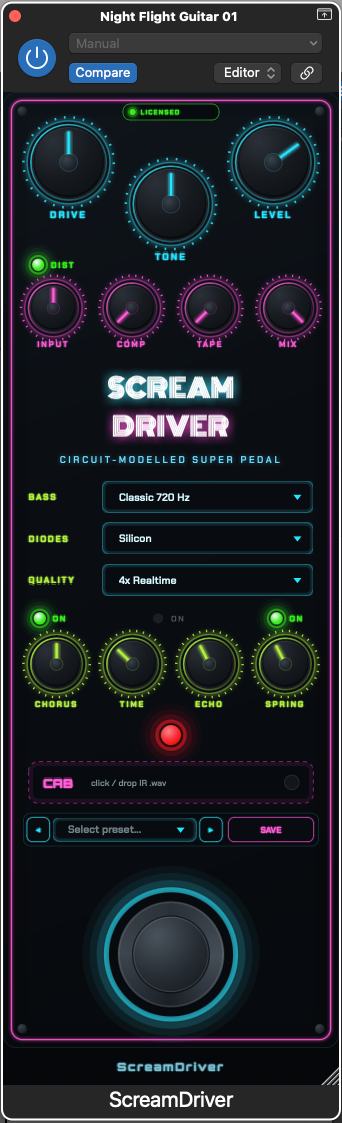
A three-stage op-amp overdrive solved from its circuit equations rather than sampled — with a pedalboard bolted on behind it: tube-style compression, magnetic tape saturation, bucket-brigade stereo chorus, pitch-bending tape echo, a spring tank that actually drips, and a zero-latency cabinet loader. Put it on a mono guitar track and it comes out wall to wall.
Most overdrive plug-ins approximate the curve. ScreamDriver solves the circuit. Every sample, it balances the feedback equation of a three-stage op-amp gain network — the 4.7k/47nF branch, the 51pF stabilising cap, the back-to-back clipping diodes — using Newton-Raphson iteration until the node voltages settle. That is why it behaves like a real pedal rather than a curve: roll your guitar volume back and it cleans up, dig in and it bites, and the op-amp's finite slew rate softens pick attack at high gain the way real silicon does.
A static transfer curve sounds the same however hard you hit it. A solved circuit does not — the operating point moves with your playing, so the pedal responds to your hands instead of just colouring your signal.
Silicon for classic symmetric squash, asymmetric for touch-sensitive amp-like grind, LED for loud, open, high-headroom crunch.
A 720 Hz corner for tight, mid-forward bite; 339 Hz to thicken single coils; 154 Hz to let drop tunings through the drive stage intact.
The 723 Hz and 3.2 kHz analogue tone network, modelled as a network rather than an EQ, with a taper that puts the sweet spot where your fingers expect it.
Polyphase IIR filtering keeps the top end silky instead of fizzy, at constant latency whichever rate you pick.
The gain stage cannot rise infinitely fast. Modelling that limit is what rounds off pick attack at high gain instead of letting it turn brittle.
The dry signal is never resampled or filtered on its way through, so blending stays phase-coherent at any mix setting.
A tube-style squish with automatic make-up gain, placed ahead of the drive stage so sustain and bloom arrive before the diodes ever see your signal.
Genuine Jiles-Atherton hysteresis solved per sample — program-dependent squash, head-bump low end, and bias-driven even harmonics. The loop is the sound.
The chain is fixed on purpose. Compression feeds the circuit, the circuit feeds the tape stage, and each one behaves differently for being in that position.
A bucket-brigade voice running the classic stereo trick: dry plus wet to the left, dry minus wet to the right. Shimmering and enormous, and it collapses cleanly to mono.
Turn TIME while it repeats and the echoes bend pitch like tape spooling up. Head-loss damping darkens every repeat. One sweep takes you from slapback to self-oscillation, 80–900 ms.
A modelled spring tank rather than a hall in disguise. Dispersion smears pick attack into the classic chirp, and the right tank is detuned from the left so the splash wraps around your head.
Runs mono to stereo — put it on a mono track and it spreads wall to wall
Drag any impulse response onto the cabinet slot and the built-in zero-latency convolver rolls off the fizz the way a real twelve-inch speaker does. Your IR is saved with the session, so a reopened project sounds like the one you closed. No separate amp simulator needed — this is a complete guitar chain in one window, and it is resizable and aspect-locked at any size.
Build your own cabinet responses — design a space or capture a real one — then drop them straight onto ScreamDriver.
Phase-coherent 4-band mastering compressor with interactive spectrum and A/B peak-hold.
AI-assisted equalizer · 9 analog voicings per band · Gemma 4 local inference.
64-voice hybrid subtractive + 6-op FM polysynth with 8 algorithms.
Multi-engine reverb: a true-stereo convolver plus six algorithms, with shimmer, freeze, duck, and delay-into-reverb.
Physically-modeled tape saturation — harmonic warmth, transient punch, smooth top end, and wow/flutter motion from a single insert.
Six-voice virtual analogue polysynth — rock-stable oscillator, creamy four-pole filter, and a two-mode stereo chorus.
3D placement panner with crosstalk cancellation. Works on headphones and real stereo monitors.
Real-time spectral suppression + envelope gate. Dual-stage attenuation with live activity meters.
AES67 / ST 2110 audio-over-IP between DAWs. Sub-5 ms on gigabit. MIT-licensed, open source.
Morphing spectral filter · 5 anchor shapes · dual-LFO motion · studio shimmer.
Stereo BBD chorus and pitch shifter. Wide, warm, and wild. AU · VST3.
BS.1770-4 loudness metering, phase scope, and a true-peak brickwall limiter. AU · VST3 · Standalone.
Real-time pitch correction — natural intonation to hard-tune, with formant preservation. AU · VST3 · Standalone.
Audio transient to MIDI generator. Tighten drums without losing groove. AU · Standalone.
Build your own impulse responses — design a space or capture a real one, deconvolve, and load it straight into Verb.
Three oscillators, eight voices, and a modulation matrix built for trouble.
A granular atmosphere engine — Drone, Reverse, Shimmer and Gliss modes, pitch-tracked grains, and a Freeze that holds a cloud indefinitely.
Sixteen voices on a step sequencer that works the way the originals did — per-voice tune, decay and filter, accent per step, and producer-style swing.
Neural amp capture and playback. Load a model or capture your own rig. Free · public beta.
Dual 6-stage optical phaser with two sweep generators. Deep 12-stage series swirls or wide parallel stereo motion.
Seven lo-fi modules on one panel — saturation, wow and flutter, bit crush, band limiting, dropouts, ambience and a ducked noise bed, under one Amount macro.
Stereo analog echo and ducking delay — tape and lo-fi character, repeat filtering, ping-pong, and program-dependent ducking.
Circuit-modelled three-stage overdrive with tube-style compression, tape saturation, BBD chorus, pitch-bending echo, spring tank and a zero-latency cabinet loader.
A MIDI plug-in that writes full ambient, neo-soul and lo-fi songs across five parts. Free · public beta.
ScreamDriver is an original Dreamlab Digital Media product. It is not affiliated with, endorsed by, or derived from any hardware or software manufacturer, and it does not model or emulate any specific third-party pedal, amplifier or effect unit. Full licence terms at dreamlabnet.com/daw2/eula.html.