Lo-fi · Saturation · Wow & flutter · Bit crush · AU · VST3 · macOS
One knob, seven kinds of wrong.
DL-LOFI puts a whole lo-fi chain on a single panel: tube and tape saturation, wow and flutter, bit and
sample-rate reduction, band limiting, magnetic dropouts, ambience and a ducked noise bed — in the
order a signal would actually meet them. One Amount macro scales all seven at once, so you audition how
far gone you want it instead of balancing fourteen controls by hand.
You can build this sound from seven plug-ins. Everyone has. The problem isn’t that it can’t be
done — it’s that once it’s built, you can’t move it. Wanting a bit less of all that
means going back through seven windows and guessing at seven amounts, and the balance you spent an hour
on falls apart on the way.
DL-LOFI puts the whole chain on one panel in fixed order, and puts one knob across it. Amount scales
every module’s depth at once, and each module decides for itself what less
means: the saturator backs off its curve, the crusher walks its bit depth back toward 16 and its divisor
toward 1, the noise bed drops away. At zero the plug-in is transparent — not quieter, not duller,
a wire. At 100% every module does exactly what its own knobs say.
Mix is separate and equal-power, because less damage and less of it are different decisions. Heavy
settings at 30–40% Mix is the standard parallel trick, and one of the factory presets is set up for
exactly that.
Why it stays put
Constant, reported latency
The wobble delay line’s 20 ms read point and the saturator’s 31-sample oversampler delay run
whether or not their modules are switched on, so the reported figure never changes while you play and
the host never re-negotiates delay compensation mid-playback. Bypass is latency-matched, which is what
makes the A/B honest.
02 / The chain
Seven stages, in the order they happen.
Fixed order, left to right on the panel. Pitch instability happens on the medium, so it comes before the electronics; the noise bed is added last, because that is where it lives on a record.
Wobble · Pitch instability
Wow, flutter and drift
Through a modulated delay line. Wow gets roughly six times the depth range of flutter, matching what the two faults actually do on a machine — high flutter over low wow is the sound of a cheap transport. Drift is a slow random walk on top, which is what stops the modulation sounding like an LFO.
Saturate · Warmth and grit
Four curves
Tube is asymmetric and adds even harmonics, so it thickens without dirtying. Tape compresses softly and loses top end as it’s pushed. Fuzz is an odd-harmonic clipper. Radio band-limits first, then clips. Runs inside a 2× oversampler.
Digital · Sampler crunch
Bit depth 16 down to 1
Continuously, over a fractional sample-rate divisor of 1 to 64 that sweeps rather than steps. Clock jitter for cheap-hardware instability, TPDF dither, and a Soften filter that tracks the reduced rate. Deliberately not oversampled: the aliasing is the effect.
Filter · Band limiting
24 dB/octave, shared resonance
That slope is what makes small speakers and telephones; a gentle roll-off just sounds dull. The Radio macro squeezes both the high-pass and the low-pass toward a 500 Hz – 2.8 kHz band in one move.
Magnetic · Damage
Dropouts, crinkle, stutter
Oxide dropouts up to about two a second, with depth down to roughly −34 dB rather than silence, because a bad patch of tape still passes something. Applied to both channels together, so it reads as damage to the medium instead of as panning.
Space · Ambience
Room, Plate, Slap, Hall
Band-limited going in, which is what keeps heavily degraded material from turning to soup. Slap is a single tape-style repeat and is often the right answer on a drum loop where a reverb would only add mud.
Noise · The bed
Vinyl, hiss, hum, rain, transport
Vinyl is a filtered bed plus a real crackle process. Level stays deliberately low across its range — noise sits under the programme, not beside it. Duck links the bed to the music so it drops under the performance and returns in the gaps, which is what makes it sound like it’s on the record rather than on top of it.
Amount · The macro
One knob across all seven
At zero the plug-in is a wire. At 100% every module does exactly what its own knobs say. Each module interprets the scaling in its own terms rather than simply turning down, so the character holds together at every point on the sweep.
03 / The panel
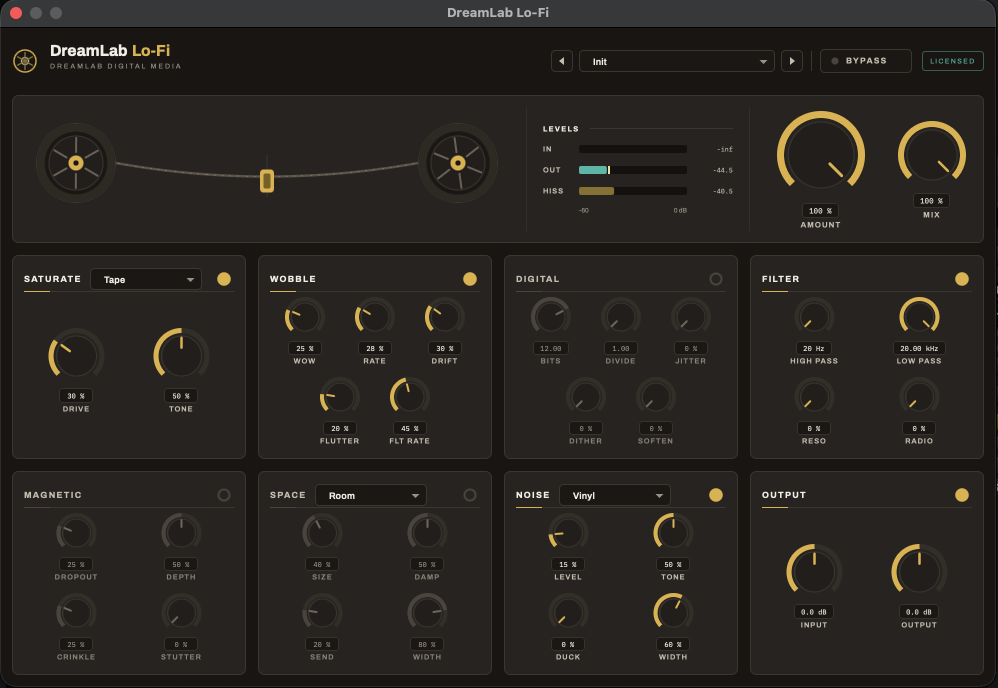
The transport is a meter.
The reels at the top of the panel aren’t decoration. They speed up and slow down with the wobble
modulation, so wow and flutter are visible as the spokes hunting — you can see the pitch moving
before you’ve trained your ear to hear it. The tape between them dims when Magnetic drops out, and
the head lamp goes dark whenever nothing is being processed.
Beside it, a levels column meters input, output and the noise bed after ducking, on a −60 to 0 dBFS
scale with a peak-hold tick and a clip cap that latches until you clear it. The noise meter is the useful
one: it’s how you set Duck by eye when the bed is too quiet to judge on laptop speakers.
A/B one stage
Every module has a lamp
The lamp is that module’s on/off, so you can take the crusher out for a second without losing what
it was set to. A switched-off module keeps its full-contrast panel and readouts — only its arcs and
values step back — because a greyed-out card reads as broken rather than bypassed.
Built to measure
Fixed window, fixed sizes
996 × 660, four knob sizes, one dark palette with a single amber accent. Double-click any control to
reset it to the preset’s value; hold Option while dragging for fine adjustment.
04 / Presets
Load one, then turn Amount.
That’s the intended workflow: the preset sets the character, Amount sets how far gone it is, Mix sets how much of the original survives. Twelve factory starting points ship with it.
Init
A clean slate with every module at its neutral setting
Beat Tape
The loop-and-sampler sound, crushed and wobbling
Worn Cassette
Slow wow, soft top end, a bed of hiss
Dusty Vinyl
Crackle, band limiting and a little groove noise
Broken Sampler
Low bit depth, hard divisor, jitter on the clock
AM Radio
Band-limited and clipped, with the Radio macro doing the work
Telephone
Narrower still — the 500 Hz – 2.8 kHz squeeze
Warm Glue
Bus duty: on and not noticed
Sleepy Keys
Wow-led drift for pads and held chords
Skipping Groove
Stutter and dropouts, the sticky-transport sound
Tape Slap
A single tape-style repeat instead of a reverb
Parallel Grit
Heavy settings at low Mix, for blending underneath
If you want to build from nothing: start on Init, bring
Saturate → Drive up until it thickens, add
Wobble → Wow until the pitch starts breathing, then bring in
Noise → Level. That’s most of the sound.
05 / Specifications
The details.
Formats
Audio Unit, VST3
Platform
macOS 12 or later, Apple Silicon or Intel — Apple M-series processor recommended
Channels
Mono, stereo, and mono input to stereo output
Latency
Constant and reported; latency-matched bypass
Modules
Seven, each independently switchable
Saturation
Tube, Tape, Fuzz, Radio — inside a 2× oversampler
Bit reduction
16 to 1 bits, continuous; sample-rate divisor 1 to 64, fractional
Band limiting
24 dB/octave high-pass and low-pass, shared resonance
Ambience
Room, Plate, Slap, Hall — band-limited input
Noise
Vinyl, tape hiss, 50/60 Hz hum, rain, transport — with programme ducking
Presets
12 factory
Automation
All parameters, including Bypass, exposed to the host
Universal — Apple Silicon and IntelAPPLE M-SERIES RECOMMENDED
SECURITY
Signed and notarised by Apple
REQUIRES
macOS 12
DreamLab Lo-Fi is an original Dreamlab Digital Media product. It is not affiliated with, endorsed by, or derived from any hardware or software manufacturer. Full licence terms at dreamlabnet.com/daw2/eula.html.