Vallaren DTR-48 GET DDM S1
VALLAREN / PLUG-INS / DDM S1
v1.0 · build 0429 Subtractive + 6-OP FM 64 Voices 0 Sample Latency

Two engines.
One voice.

DDM S1 is an '80s-inspired virtual synthesizer — a software instrument that lives inside your DAW and gives you the sounds of that era's iconic hybrid synths, redrawn for a modern session. An analog-voiced subtractive engine and a 6-operator FM engine run in parallel inside every voice, summed through a state-variable filter, soft tanh drive, and a three-stage analog FX bus — plus a 16-pad velocity-layered drum kit on the same chain — up to eight samples per pad, smoothly crossfaded as you play harder. The result is a single instrument that can be a warm pad, a glassy bell, a chrome bass, or a full kit — and is yours to shape into a sound nobody else has.

Polyphony64 voices
FM Operators6 + feedback
Algorithms8
Drum Pads16 × up to 8 layers
Latency0 samples
FormatsAU · VST3
VoicePOLY 64
Preset03 · POLY BRASS
CPU3.4%
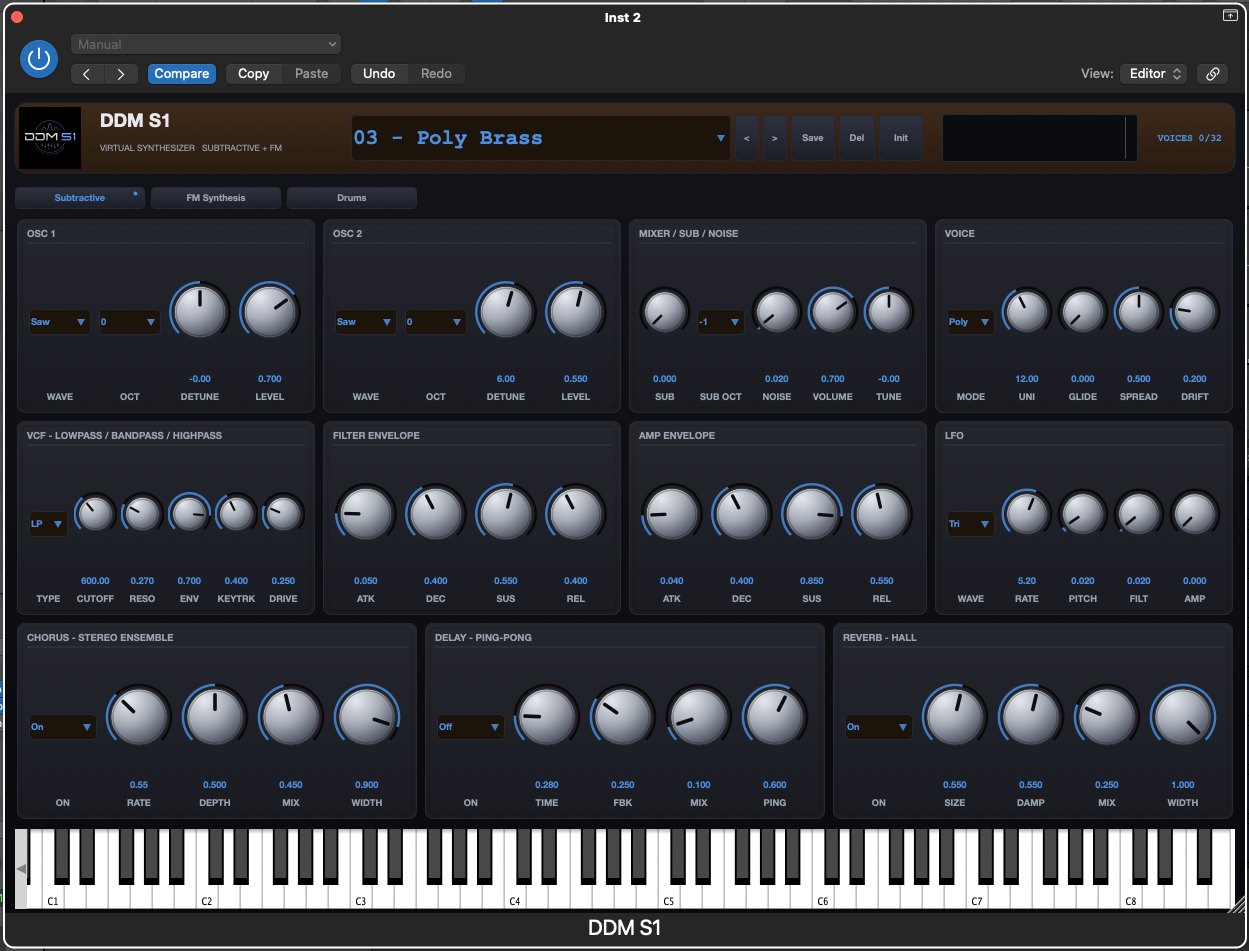
DDM S1 — Subtractive view
01 / Architecture

One voice, two engines, summed at the mixer.

Every one of the sixty-four voices carries both engines simultaneously. They render in parallel and meet at a per-voice mixer with independent levels — so a single held note can be a pure analog pad, a pure FM bell, or any cross-fade between them. The combined signal then runs through a soft saturator, a 12 dB/oct multimode SVF, an amp envelope, a stereo panner, and out to the global effects bus.

Subtractive path FM path Shared signal chain × 64 voices · per-voice stereo panner
02 / The two engines

An analog warmth. A digital bite. In the same voice slot.

Subtractive · Analog Lineage

Two DCOs, sub, noise — through a TPT state-variable filter.

Two anti-aliased oscillators with selectable saw / square / triangle / sine (polyBLEP — clean above the fifth octave), a square sub-octave generator, and white noise feed a soft tanh drive into a 12 dB/oct multimode resonant filter. Resonance is musical without going shrill at the top. A small per-trigger pitch drift keeps chords from sounding crystal-locked.

  • Oscillators2 × DCO + Sub + Noise
  • Anti-aliasingpolyBLEP
  • Filter12 dB/oct TPT-SVF
  • ModesLP · BP · HP
  • EnvelopesFilter · Amp ADSR
  • DriveSoft tanh, per-voice
6-OP FM · Digital Lineage

Six sine operators, eight algorithms, per-op envelopes.

Six pure sine oscillators with programmable harmonic ratios from 0.5× to 16×, wired together in eight algorithms — from a deep serial chain through stacked carriers, parallel pairs, and a six-partial additive bank — plus self-feedback on Op 6 for saw and square approximations. Each operator carries its own ADSR, so the metallic strike of an electric piano can decay independently of the body tone — the move that makes FM electric pianos sing.

  • Operators6 × sine + Op 6 FB
  • Ratios0.5× · 1×–8× · 10/12/16×
  • Algorithms8
  • Per-op envelopeADSR
  • VoicingsBell · EP · Bass · Pad
  • Hybrid layerSums into voice mix
03 / FM Algorithms

Eight wirings of six operators — everything from glass to bass.

The classical FM intuition: which operators modulate the others, and which sum directly to the audio output. DDM S1 ships eight algorithms — a deep serial chain at one extreme, a six-sine additive bank at the other, and six useful patterns in between. Op 6 always carries a self-feedback path for the in-built saw approximation.

ALG · 00
Serial

A pure six-deep modulation chain. Op 6 (with feedback) drives Op 5, drives 4, 3, 2, into carrier Op 1. The deepest, most spectrally complex sounds in the engine — each operator’s envelope shapes a different harmonic layer.

ALG · 01
5→1

Five modulators feeding one carrier in parallel, with one short side‑chain (Op 6 → Op 5). Massive parallel modulation density. Great for FM brass, distorted leads, and “more index than necessary” character patches.

ALG · 02
4→1

All five modulators stacked in parallel onto Op 1. No side-chains — just the simplest “everything on one carrier” topology. Use the per-op ratios and envelopes to dial in bell tones, electric pianos, and biting brass.

ALG · 03
Twin

Two independent three-operator chains, summed at the output. Op 3 → 2 → 1 alongside Op 6 → 5 → 4 (with feedback). Two distinct FM voices in one slot — bell over sub, lead over pad, evolving on independent envelopes.

ALG · 04
Pairs

Three independent two-operator FM pairs running in parallel: 2→1, 4→3, 6→5 (with feedback on Op 6). Best for layered patches where each pair occupies a different harmonic register — low, mid, high.

ALG · 05
Triad+Stk

Two pure-sine carriers (Op 1, Op 2) plus one richly-modulated voice — Op 6 → 5 → 4 → 3, with Op 3 as carrier. Choir-like additive base with one expressive FM voice on top. Hybrid pads where part of the sound stays glassy-pure.

ALG · 06
Y-Split

Three modulators (Op 3, 4, 5) converge on intermediate carrier Op 2, which drives final carrier Op 1. Op 6 deepens the Op 5 branch. Dense, bell-like harmonic spreads with three independent envelopes shaping the strike onset.

ALG · 07
Additive

All six operators are carriers, summed directly. Pure additive synthesis at six partials. Op 6 retains its self-feedback path so the highest partial can lean from sine toward saw. Organ-like patches, formant-style vowels, harmonic-stack pads.

04 / Features

The small details that make a synth feel alive.

F.01

polyBLEP-clean oscillators on every key

Every saw, square, and triangle waveform is band-limited with a polynomial BLEP algorithm. The result: the high notes stay clean above the fifth octave, no zipper aliasing on lead lines, no digital crunch on supersaws stacked at the top of the keyboard. The sub-oscillator extends a square wave one or two octaves below the played note for true low-end weight.

polyBLEP · Saw · Square · Triangle · Sine · Sub
F.02

TPT state-variable filter — musical resonance to self-oscillation

A 12 dB/oct multimode filter implemented in topology-preserving transform form, switchable LP / BP / HP. Resonance is musical at any setting, accepts modulation from a full ADSR plus key tracking and the global LFO, and stays stable when you push it into self-oscillation territory. The kind of filter people compliment without knowing why.

12 dB/oct · LP / BP / HP · TPT-form · key tracking
F.03

Three voice modes — Poly, Mono, Unison

Poly gives you 32-voice polyphony with oldest-voice stealing. Mono adds proper portamento for legato bass and lead playing. Unison stacks three detuned voices per note across the full stereo field for the supersaw tones that have powered a generation of trance, synthwave, and modern pop. A small analog-style pitch drift adds randomness at every note trigger, so chords don't sound like they were generated by a single quartz crystal.

Poly · Mono + glide · Unison × 3 · per-trigger drift
F.04

Per-operator FM envelopes — the move that defines an FM electric piano

Each of the six FM operators carries its own ADSR. The metallic strike of a tine on the FM E.Piano can decay in 200 ms while the body tone sustains for a beat. The percussive attack of the FM Bell can ride entirely on Op 4's envelope while Op 1 holds the long, glassy ring. This is the trick that gives FM pianos their distinctive bell-against-felt quality — and it's wired into the architecture, not an afterthought.

6 × ADSR · independent attack & decay · log taper
F.05

A three-stage analog effects bus

A bucket-brigade-style stereo ensemble chorus with dual quadrature LFOs for lush movement. A ping-pong delay with damped feedback for rhythmic spaces. An algorithmic hall reverb — not convolution, which is why it adds zero processing latency. Room size, damping, and width sweep from a tight close-mic to a cathedral inside one knob.

Chorus · Ping-Pong Delay · Hall Reverb · 0 latency
F.06

Per-voice LFO with phase reset on every note-on

Sine, triangle, square, and sample-and-hold shapes, free-running from 0.05 to 20 Hz, assignable to pitch, filter cutoff, or amplitude. The LFO phase resets at every note-on — a small detail that means chords sound coherent rather than chaotically beating against themselves. The kind of choice that distinguishes a synth designed by someone who plays one.

Sin · Tri · Sqr · S&H · Pitch · Cutoff · Amp
F.07

Real-time-safe DSP, lock-free parameters

No dynamic memory allocation in the audio thread. No file I/O. No FFT, no convolution, no oversampling, no lookahead — pure stream processing throughout. Parameter access is via lock-free atomic loads, hoisted to block-rate so the per-sample inner loop stays free of host synchronization. On a current-generation Mac at a 64-sample buffer, round-trip latency from MIDI controller through the host to audio out clocks at ~1.5 ms. Sixty-four voices with all effects engaged stays comfortable on a single core. Live-performable, not just demoable.

RT-safe · lock-free · 0 sample latency · ~1.5 ms RT
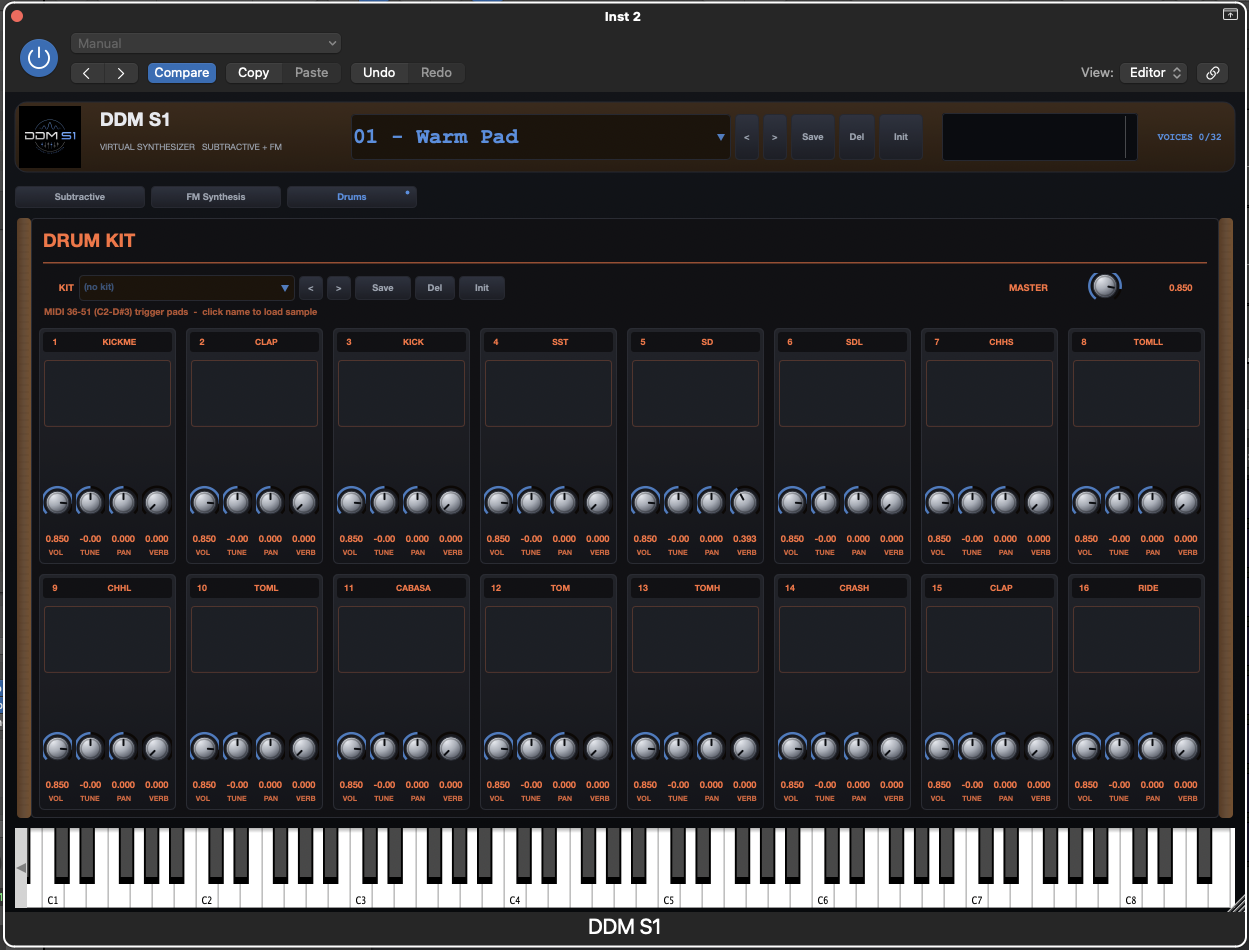
Drum Kit · 16 pads · GM-default routing DDM S1 — 16-pad sample-based drum kit
Third workspace

A 16-pad velocity-layered drum kit in the same instrument slot.

Sixteen pads, and every pad holds up to eight velocity-layered samples. Hit softly, hear the soft sample; dig in, hear the loud one — exactly the way a real acoustic drum behaves under the stick. The engine smoothly crossfades adjacent layers across a ±0.05 equal-power window so transitions disappear into the playing, no machine-gun stepping between zones. Layer thresholds are user-definable per pad; defaults are equal-spaced. Two voice slots per pad keep both layers ringing through the crossfade region.

Right-click any pad for full per-layer control — add, replace, clear, or retune thresholds without disturbing the rest. Hover for a live tooltip showing every loaded layer's filename and velocity range. Each pad accepts WAV, AIFF, FLAC, or OGG, loaded fully into RAM for zero-latency triggering, with per-pad VOL · TUNE · PAN · REVERB-SEND and configurable MIDI routing (GM range, channel 10, or a custom 16-note window from any C). Drums bypass chorus and delay so transients stay tight, but each pad sends into the synth's hall reverb — a snare can be drenched while the kick stays bone-dry. Save and load complete kits as portable XML; old single-sample kits load identically as one-layer kits.

Pads16 4×4 grid
Layers / pad1–8 velocity-zoned
Crossfade±0.05 equal-power
Per-padVOL · TUNE · PAN · VERB
MIDIPer-pad note routing
Kit MgmtSave · Load · Recall
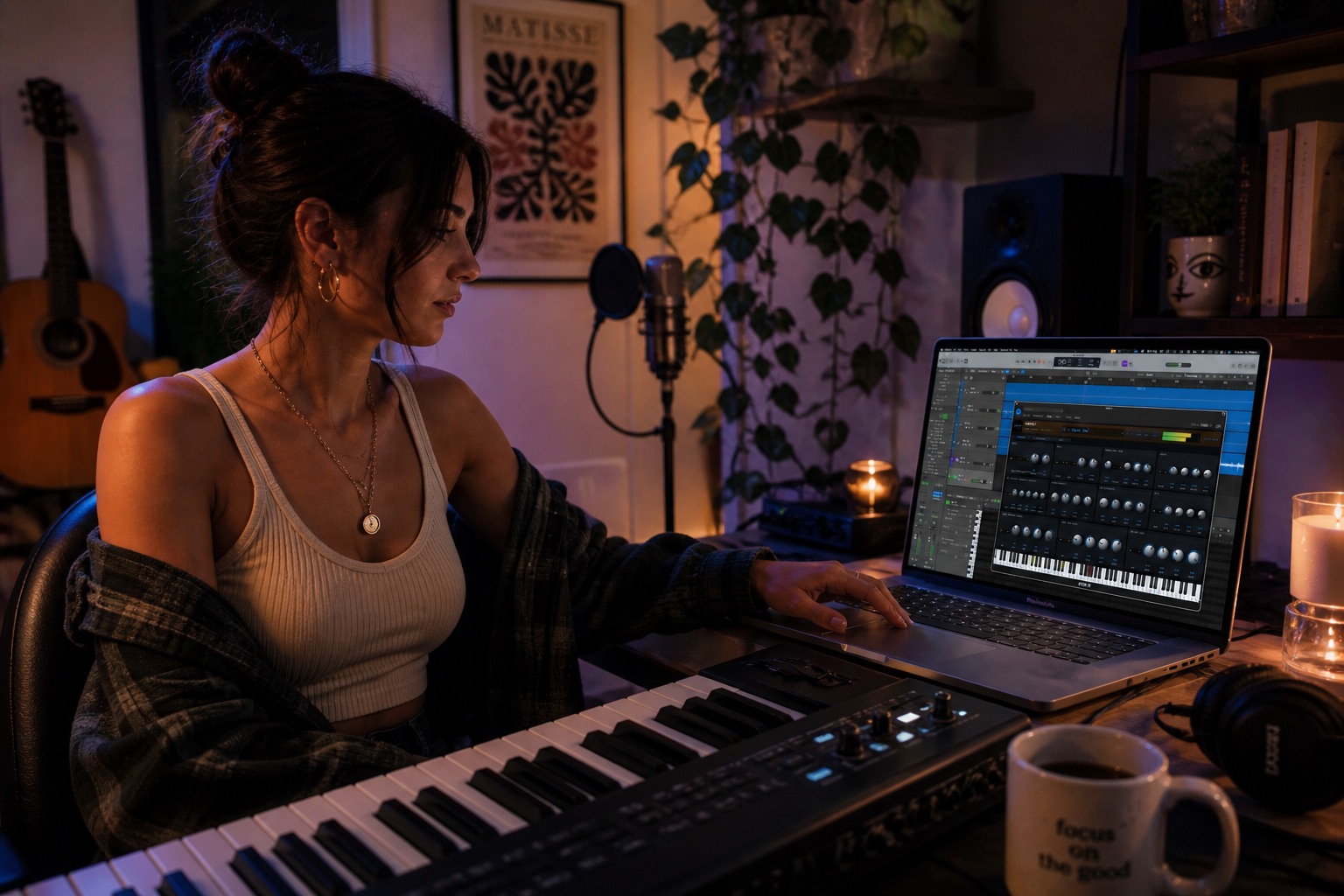
Sound different A producer at her workstation, DDM S1 open in the DAW, MIDI keyboard in front of her
Sound different

The tools to shape your own sound — not a different preset of someone else’s. Two original engines, an operator-level FM core, and a sample kit that all live in one instrument slot.

Sub · FM · Drum kit · one instrument, your sound
DSP lineage
Original
Engines combined
Sub + FM
Sounds like
You
07 / At-a-glance

Specifications.

Plugin formatsAudio Unit · VST3 · Standalone (macOS, Apple Silicon native)
Polyphony64 voices, oldest-voice stealing
Voice modesPoly · Mono (with glide) · Unison (7-voice stack)
Velocity response4 curves (Linear / Soft / Hard / Fixed) + sensitivity (V→Amp), applies to synth and drums
Subtractive osc2 × DCO (Saw / Sqr / Tri / Sin), polyBLEP anti-aliased, ±2-octave per oscillator
Sub oscillatorSquare wave, –1 or –2 octave
NoiseWhite noise generator
Per-engine octave shift±2 octaves on Sub side and FM side independently
Sub-engine filter12 dB/oct multimode SVF (LP / BP / HP), TPT topology, ADSR + key-tracking + soft drive
FM-engine filterIndependent 12 dB/oct multimode SVF (LP / BP / HP) with its own ADSR, key-tracking, and drive
EnvelopesSub Filter ADSR · Sub Amp ADSR · FM Filter ADSR · FM Amp ADSR · 6 × FM-op ADSR (11 envelopes per voice)
LFOSin / Tri / Sqr / S&H · 0.05–20 Hz · per-voice phase reset on note-on · routes to pitch / filter / amp
FM operators6 sine operators with programmable harmonic ratio + per-op level + per-op ADSR
FM ratios0.5×, 1×, 2×, 3×, 4×, 5×, 6×, 7×, 8×, 10×, 12×, 16×
FM algorithms8 (Serial · 5→1 · 4→1 · Twin · Pairs · Triad+Stk · Y-Split · Additive)
FM feedbackOp 6 self-feedback path
FM anti-aliasingPer-voice 16 kHz post-FM lowpass safety net
Drum Kit16-pad velocity-layered sample player · 1–8 layers per pad · per-pad VOL / TUNE / PAN / REVERB-SEND · kit save/load · WAV / AIFF / FLAC / OGG
Drum velocity layersPer pad: 1–8 samples, user-definable top-velocity thresholds, ±0.05 equal-power (cos/sin) crossfade window between adjacent layers, 2 voices per pad to span crossfade region
Drum layer UIRight-click pad → Add / Replace / Clear / Threshold edit / Reset (equal spacing) / Clear All · hover tooltip lists every layer's filename + velocity range · pad header shows layer count (e.g. kick_soft ×3)
Drum MIDI routingOff · Channel 10 (GM convention) · Note Range with selectable start note (C-1 to C8)
Drum signal flowBypasses chorus/delay (transient-clean) · per-pad reverb send into the synth's hall
EffectsStereo Chorus (Poly-6 style) · Stereo Ping-Pong Delay · Hall Reverb (per-engine on/off)
SaturationSoft tanh drive on Sub side, FM side, and master
Master sectionVolume · Tune (±50 ¢) · smoothed peak limiter · stereo VU output meter
Presets25 factory presets (subtractive, FM, hybrid, drums) + unlimited user presets stored as portable XML in ~/Library/Audio/Presets/Dream Lab LV/DDM S1/
DiagnosticsBuilt-in Debug button — copies a state snapshot (active voices, peak-hold per pipeline stage, audio-thread CPU%) to the clipboard
Latency0 samples processing latency
Parameters120+ host-automatable
EngineC++17 · polyBLEP / TPT-SVF / algorithmic reverb · block-rate APVTS access · lock-free atomic loads
08 / More from DreamLab

The rest of the rack.

Dynamics

Multiband

Phase-coherent 4-band mastering compressor with interactive spectrum and A/B peak-hold.

Equalizer

Muse EQ

AI-assisted equalizer · 9 analog voicings per band · Gemma 4 local inference.

Modulation

DuoPhase

Dual 6-stage optical phaser with two sweep generators. Deep series swirls or wide parallel stereo motion.

Synthesizer

Vorion

Three oscillators, eight voices, and a modulation matrix built for trouble.

Overdrive

ScreamDriver

Circuit-modelled three-stage overdrive with tube-style compression, tape saturation, BBD chorus, pitch-bending echo, spring tank and a zero-latency cabinet loader.

Granular atmosphere

Lush

A granular atmosphere engine — Drone, Reverse, Shimmer and Gliss modes, pitch-tracked grains, and a Freeze that holds a cloud indefinitely.

Rhythm composer

DreamLab Drum Machine

Sixteen voices on a step sequencer that works the way the originals did — per-voice tune, decay and filter, accent per step, and producer-style swing.

Neural amplifier

Zelos

Neural amp capture and playback. Load a model or capture your own rig. Free · public beta.

Lo-fi

DreamLab Lo-Fi

Seven lo-fi modules on one panel — saturation, wow and flutter, bit crush, band limiting, dropouts, ambience and a ducked noise bed, under one Amount macro.

Delay

DreamLab Delay

Stereo analog echo and ducking delay — tape and lo-fi character, repeat filtering, ping-pong, and program-dependent ducking.

Currently viewing

DDM S1

64-voice hybrid subtractive + 6-op FM polysynth with 8 algorithms.

Reverb

Convolution Reverb

Multi-engine reverb: a true-stereo convolver plus six algorithms, with shimmer, freeze, duck, and delay-into-reverb.

Saturation

SAT 456

Physically-modeled tape saturation — harmonic warmth, transient punch, smooth top end, and wow/flutter motion from a single insert.

Synthesizer

Synth CH388

Six-voice virtual analogue polysynth — rock-stable oscillator, creamy four-pole filter, and a two-mode stereo chorus. Zero latency, one panel.

Spatializer

Binaural Panner

3D placement panner with crosstalk cancellation. Works on headphones and real stereo monitors.

Restoration

Adaptive Noise Reducer

Real-time spectral suppression + envelope gate. Dual-stage attenuation with live activity meters.

Networking · free

AudioOverNetwork

AES67 / ST 2110 audio-over-IP between DAWs. Sub-5 ms on gigabit. MIT-licensed, open source.

Spectral filter

Sound Morph

Morphing spectral filter · 5 anchor shapes · dual-LFO motion · studio shimmer.

Modulation

D Chorus

Stereo BBD chorus and pitch shifter. Wide, warm, and wild. AU · VST3.

Metering

LUFS Master

BS.1770-4 loudness metering, phase scope, and a true-peak brickwall limiter. AU · VST3 · Standalone.

Pitch

Pitch Corrector

Real-time pitch correction — natural intonation to hard-tune, with formant preservation. AU · VST3 · Standalone.

Drum trigger

Drum Trigger

Audio transient to MIDI generator. Tighten drums without losing groove. AU · Standalone.

Companion tool

Impulse Lab

Build your own impulse responses — design a space or capture a real one, deconvolve, and load it straight into Verb.

MIDI generator · free

Vibe Generator

A MIDI plug-in that writes full ambient, neo-soul and lo-fi songs across five parts. Free · public beta.

STATUS
In development — not yet released
PLANNED FORMATS
AU · VST3
ARCHITECTURE
Universal — Apple Silicon and IntelAPPLE M-SERIES RECOMMENDED

DDM S1 is an original Dreamlab Digital Media product. It is not affiliated with, endorsed by, or derived from any hardware or software manufacturer. Specifications are provisional until release.