Vallaren DTR-48 GET DL-DELAY
VALLAREN / PLUG-INS / DreamLab Delay
Delay · Stereo analog echo · Ducking delay · AU · VST3 · macOS

Echo that gets out of the way.

DL-DELAY pairs a clean stereo delay engine with tape warmth, lo-fi grit, repeat filtering, stereo widening, ping-pong and program-dependent ducking — so the repeats bloom in the gaps of a performance and step aside the moment the source comes back. Slapback, wide rhythmic echoes, drifting tape repeats, dark dub feedback and long ambient tails, from one focused panel.

Get DL-DELAY The sound →
Delay time1–2,000 ms · tempo sync
CharacterClean · Tape · Lo-Fi
DuckingInput or external sidechain
Presets9 factory starting points
DL-DELAY · Stereo analog echo / ducking delay
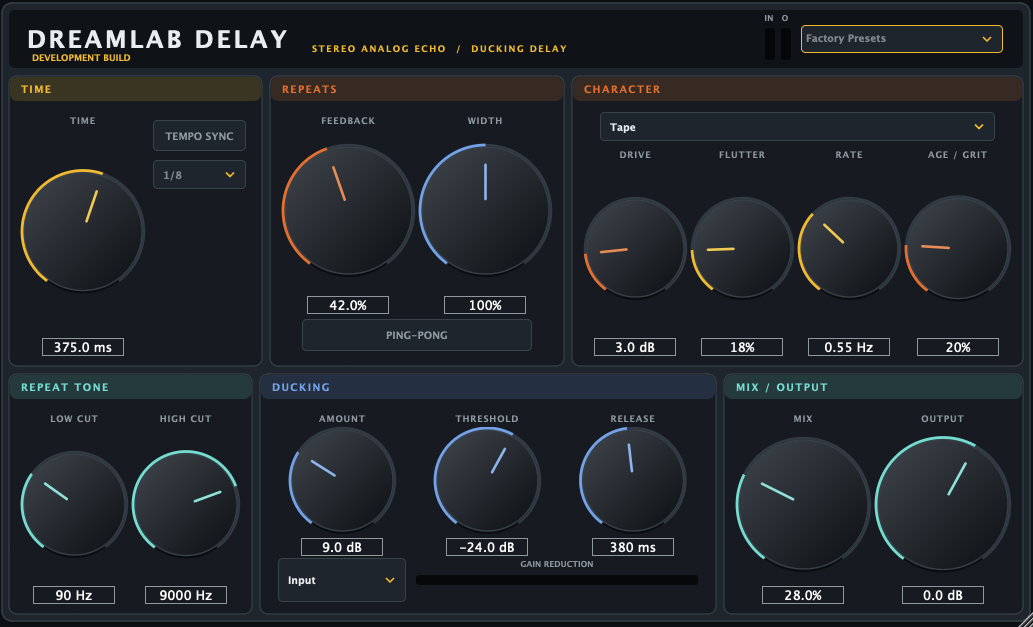
DL-DELAY interface — Time, Repeats, Character, Repeat Tone, Ducking and Mix / Output sections
01 / The sound

Depth without the mud.

Most delays fail in the same place: they sound beautiful on the solo track and smear the moment the arrangement comes back. DL-DELAY is built around that problem. The repeat path carries its own low and high cut, so each echo gets progressively narrower and sits behind the source instead of competing with it. Character shapes only the repeats — soft tape saturation, gentle compression, age and organic pitch movement, or a deliberately degraded lo-fi texture — while the dry signal stays untouched. And ducking watches the performance, pulling the echoes down under the words and letting them rise in the spaces. Independent Input and Output trims close the loop: drive the character section hard, pull the output back by the same amount, and compare against bypass at honest, matched loudness.

Why it stays clean

Four-point interpolation

Fractional delay reads use four-point interpolation, and every control — time, feedback, tone, character, width, gain — is smoothed. Moving the delay time warps pitch naturally rather than clicking, and band-limited flutter gives organic movement instead of rapid random stepping.

02 / Signal flow

Where the dry signal goes.

DRY PATH · UNTOUCHED · CENTRED FOR MONO SOURCES INPUT TRIM DELAY CHARACTER FILTERS DUCK GAIN WIDTH / P-PONG MIX CONST. POWER OUTPUT FEEDBACK · LIMITED TO 97% FOR FINITE, STABLE DECAY KEY SIGNAL · MAIN INPUT OR HOST SIDECHAIN
Wet path: trim → delay → character → repeat filters → ducking gain → width / ping-pong. Filtering sits inside the feedback loop, so every pass narrows further.
Filters in the loop

Repeats that recede

Low Cut and High Cut are inside the repeat path, not after it. Each successive echo is filtered again, so a long feedback tail darkens and narrows on its own — the dub engineer's trick, built in.

Mono in, stereo out

The dry stays centred

Feed a mono guitar or vocal into a stereo bus and the dry path stays centred instead of collapsing to one side, with width and ping-pong acting only on the echoes.

Gain staging

Input and Output are separate

Input trims −18 to +18 dB into the delay and character engine; Output trims −18 to +12 dB on the way out. Drive one, pull the other, and A/B against bypass at matched level.

03 / Character

Three ways for a repeat to age.

Character processes the echoes only — the dry signal never enters it. Drive sets how hard the repeats hit the processing, Flutter and Rate set the depth and speed of the delay-time movement, and Age / Grit adds wear, darkness and instability appropriate to the mode.

Mode 01 · Clean

Transparent

The most neutral path through the engine. Repeats come back as recorded — the reference point for tight modern delays and for hearing exactly what the filters and ducking are doing.

Mode 02 · Tape

Warm & drifting

Soft saturation, gentle compression, age and organic pitch movement. DC-safe and gain-compensated, so pushing Drive adds weight and harmonics rather than level and offset.

Mode 03 · Lo-Fi

Degraded & gritty

A deliberately damaged repeat texture — narrower, grittier, more unstable. Age / Grit pushes it from worn to broken, and behaviour holds consistent across common sample rates.

CLEAN · STEADY TAPE · FLUTTER + AGE LO-FI · GRIT + INSTABILITY
Each mode's repeat train: steady in Clean, drifting and softening in Tape, smeared and unstable in Lo-Fi.
04 / Ducking

The echoes wait their turn.

KEY SIGNAL · DRY PERFORMANCE THRESHOLD DELAY LEVEL · DUCKED UNITY AMOUNT RELEASE → RELEASE →
Above the threshold the repeats are held down by Amount; below it they return at the speed set by Release. The gain-reduction meter shows it happening.

Ducking controls

Section 05 · program-dependent
  • AmountMaximum reduction applied to the delayed signaldB
  • ThresholdLevel at which ducking beginsdBFS
  • ReleaseHow quickly the echoes return after the key falls awayms
  • Key sourceMain dry signal, or a host-routed external busInput / Sidechain
  • Gain reductionLive meter of the active duckingMeter

Repeat tone

Section 04 · inside the loop
  • Low CutRemoves low-frequency energy from the echoesHz
  • High CutDarkens the echoes so they sit behind the sourceHz
  • FeedbackHow much delayed signal returns to the line0 – 97%
  • WidthMono through extra-wide stereo imageMono – extra-wide
  • Ping-PongAlternates repeats left and rightOn / Off

If the host provides no active sidechain bus, DL-DELAY falls back to the main input rather than going silent or holding the echoes down — so a session that loses its sidechain routing still plays back sensibly.

05 / Stereo

Ping-pong, and past the speakers.

L R DRY · CENTRED TAP 1 TAP 2 TAP 3 TAP 4 TAP 5
Ping-pong alternates each repeat between channels; Width scales the image from mono through extra-wide while the dry signal stays put.
06 / Features

Six sections, no menus.

Time

1 ms to 2 seconds

Free-running from 1 to 2,000 ms, or locked to host tempo with straight, dotted and triplet note divisions. Time changes are smoothed into a natural pitch warp instead of a click.

Repeats

Feedback to 97%

Capped for finite, stable decay, with protective processing in the loop that keeps intense settings controlled while preserving a musical tail.

Character

Clean, Tape, Lo-Fi

Drive, Flutter, Rate and Age / Grit shape the repeats only. Tape is DC-safe and gain-compensated; both coloured modes behave consistently across sample rates.

Ducking

Internal or external key

Amount, Threshold and Release, keyed from the dry input or a host-routed sidechain, with a gain-reduction meter and a safe fallback when no sidechain is present.

Metering & bypass

Honest comparison

IN and OUT meters in the header, licence status alongside them, and a click-free bypass that returns the unity-gain dry signal — automatable from the host.

Presets

Nine starting points

Vocal, slapback, ping-pong, dub and ambient patches that are meant to be moved — every control stays fully adjustable after a preset loads.

Factory presets

Nine places to start.

Init: Warm EchoDefaultA usable tape-tinged echo the moment the plug-in loads.
Vocal: Clear QuarterVocalSynced quarter notes, filtered and ducked so the words stay in front.
Vocal: External DuckSidechainKeyed from a host sidechain bus for send-based vocal delay.
Stereo: Wide Ping PongStereoAlternating repeats past the speakers with moderate-to-high feedback.
Tape: Slapback 115 msTapeOne or two driven repeats with modest flutter and grit.
Tape: Drifting EighthTapeSynced eighths with enough movement to sound unstable in the right way.
Lo-Fi: Crushed ThrowLo-FiA degraded repeat for throws and single-word effects.
Dub: Dark FeedbackDubHigh feedback, aggressive repeat filtering, progressively darker decay.
Ambient: Long StereoAmbientLong, wide, quiet repeats for pads and tails.
07 / Recipes

Six settings worth knowing.

Vocals

Clear vocal delay

Tempo Sync on, quarter or eighth division. Moderate Feedback and Mix. Raise Low Cut, lower High Cut, then increase Ducking Amount until every word stays clear.

Guitars

Tape slapback

Sync off, Time between 80 and 140 ms. Tape mode, low Feedback for one or two repeats, then Drive, modest Flutter and moderate Age / Grit.

Width

Wide ping-pong

Sync and Ping-Pong on, Width above 100%, moderate-to-high Feedback. Keep Mix low on an insert, or push it up when the plug-in is running as a send.

Dub

Dark dub feedback

Tape mode and high Feedback. Raise Low Cut and lower High Cut so the repeats narrow with each pass, then add Drive and Age / Grit for a denser, darker decay.

Mixing

External sidechain

Route the key signal to DL-DELAY's sidechain input in the host and switch Ducking to Sidechain. Set Threshold until the meter responds reliably, then Amount and Release.

Reference

Honest A/B

Raise Input to push Tape or Lo-Fi harder, then lower Output by roughly the same amount. Bypass now compares tone rather than loudness.

08 / At a glance

The specs.

Delay time
1–2,000 ms
Feedback
0–97%
Character modes
3
Input / Output trim
±18 dB
Factory presets
9
Interpolation
4-point
Formats
AU · VST3
Framework
JUCE 9
Product codeDL-DELAY · version 1.0.0
FormatsAudio Unit (AU) and VST3
Operating systemmacOS 11 or later
ProcessorsApple silicon and Intel — Apple M-series processor recommended
ChannelsMono, stereo, and mono input to stereo output
AutomationAll parameters, including Bypass, exposed to the host
SidechainHost-routed external key, with fallback to the main input
DeveloperDreamlab Digital Media
More from DreamLab

The rest of the rack.

Dynamics

Multiband

Phase-coherent 4-band mastering compressor with interactive spectrum and A/B peak-hold.

Equalizer

Muse EQ

AI-assisted equalizer · 9 analog voicings per band · Gemma 4 local inference.

Synthesizer

DDM S1

64-voice hybrid subtractive + 6-op FM polysynth with 8 algorithms.

Reverb

Convolution Reverb

Multi-engine reverb: a true-stereo convolver plus six algorithms, with shimmer, freeze, duck, and delay-into-reverb.

Saturation

SAT 456

Physically-modeled tape saturation — harmonic warmth, transient punch, smooth top end, and wow/flutter motion from a single insert.

Synthesizer

Synth CH388

Six-voice virtual analogue polysynth — rock-stable oscillator, creamy four-pole filter, and a two-mode stereo chorus.

Spatializer

Binaural Panner

3D placement panner with crosstalk cancellation. Works on headphones and real stereo monitors.

Restoration

Adaptive Noise Reducer

Real-time spectral suppression + envelope gate. Dual-stage attenuation with live activity meters.

Networking · free

AudioOverNetwork

AES67 / ST 2110 audio-over-IP between DAWs. Sub-5 ms on gigabit. MIT-licensed, open source.

Spectral filter

Sound Morph

Morphing spectral filter · 5 anchor shapes · dual-LFO motion · studio shimmer.

Modulation

D Chorus

Stereo BBD chorus and pitch shifter. Wide, warm, and wild. AU · VST3.

Metering

LUFS Master

BS.1770-4 loudness metering, phase scope, and a true-peak brickwall limiter. AU · VST3 · Standalone.

Pitch

Pitch Corrector

Real-time pitch correction — natural intonation to hard-tune, with formant preservation. AU · VST3 · Standalone.

Drum trigger

Drum Trigger

Audio transient to MIDI generator. Tighten drums without losing groove. AU · Standalone.

Companion tool

Impulse Lab

Build your own impulse responses — design a space or capture a real one, deconvolve, and load it straight into Verb.

Synthesizer

Vorion

Three oscillators, eight voices, and a modulation matrix built for trouble.

Overdrive

ScreamDriver

Circuit-modelled three-stage overdrive with tube-style compression, tape saturation, BBD chorus, pitch-bending echo, spring tank and a zero-latency cabinet loader.

Granular atmosphere

Lush

A granular atmosphere engine — Drone, Reverse, Shimmer and Gliss modes, pitch-tracked grains, and a Freeze that holds a cloud indefinitely.

Rhythm composer

DreamLab Drum Machine

Sixteen voices on a step sequencer that works the way the originals did — per-voice tune, decay and filter, accent per step, and producer-style swing.

Neural amplifier

Zelos

Neural amp capture and playback. Load a model or capture your own rig. Free · public beta.

Modulation

DuoPhase

Dual 6-stage optical phaser with two sweep generators. Deep 12-stage series swirls or wide parallel stereo motion.

Lo-fi

DreamLab Lo-Fi

Seven lo-fi modules on one panel — saturation, wow and flutter, bit crush, band limiting, dropouts, ambience and a ducked noise bed, under one Amount macro.

Currently viewing

DreamLab Delay

Stereo analog echo and ducking delay — tape and lo-fi character, repeat filtering, ping-pong, and program-dependent ducking.

MIDI generator · free

Vibe Generator

A MIDI plug-in that writes full ambient, neo-soul and lo-fi songs across five parts. Free · public beta.

FORMATS
AU · VST3
ARCHITECTURE
Universal — Apple Silicon and IntelAPPLE M-SERIES RECOMMENDED
SECURITY
Signed and notarised by Apple
REQUIRES
macOS 11

DreamLab Delay is an original Dreamlab Digital Media product. It is not affiliated with, endorsed by, or derived from any hardware or software manufacturer. Full licence terms at dreamlabnet.com/daw2/eula.html.