Vallaren DTR-48 GET ADAPTIVE NOISE REDUCER
VALLAREN / PLUG-INS / Adaptive Noise Reducer
Real-time spectral suppression · No noise print required

Cleanup that learns the noise as it plays.

Adaptive Noise Reducer is a two-stage real-time noise reduction processor. A smoothed gate clamps the silences, and a 1024-point STFT engine tracks the noise floor in 513 frequency bins and lifts only the parts of the signal that rise above it. Drop it on a track, set a few knobs, and it adapts to whatever it hears — no offline noise capture, no separate pass, no "find me ten seconds of just hiss" workflow.
GET ADAPTIVE NOISE REDUCER — $39 How it works ↓
Version1.0
ArchitectureGate → STFT
FFT1024 pt · 75% overlap
Bins513
Latency23 ms @ 48 kHz
FormatsAU · VST3 · Standalone
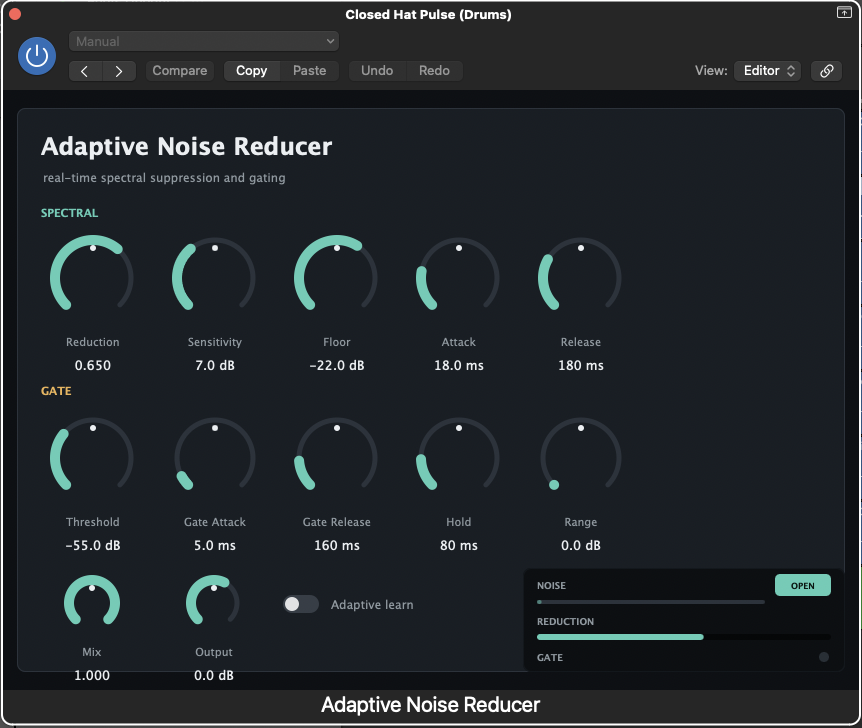
Adaptive Noise Reducer plugin interface
01 / Signal flow

Two stages. Gate first, spectral second.

A plain gate is fast but binary — it either lets audio through or doesn't. An offline spectral tool is precise but needs a noise print and a render pass. Adaptive Noise Reducer puts both in series so each one handles the part of the signal it's good at: the gate clamps the silences between phrases, and the spectral processor surgically cleans up the noise inside the phrases.

Fig. 1.1 Top-level signal path
stereo or mono · 1024 sample latency
IN audio Stage 1 Smoothed Gate Threshold · Hold · Range Attack · Release Stage 2 Adaptive STFT Per-bin noise tracking Reduction · Sensitivity · Floor Wet / Dry Mix Mix · Output DRY PATH (parallel) OUT clean handles silence handles noise inside signal
Stage 1 handles silence — when nothing's playing, slam the floor.  ·  Stage 2 handles the inside of the signal — keep the wanted bins, attenuate the noisy ones.  ·  A parallel dry path lets you blend natural texture back in via Mix.
Stage 01 · Gate

Brute-force layer

Watches the input level. Opens above Threshold, holds open for the configured Hold time, then closes gradually — attenuating by Range dB. Separate Gate Attack and Gate Release times control how snappy the open/close transitions are.

  • 01Placed before spectral so the smarter processor downstream doesn't waste effort on parts of the signal that have already been turned off.
  • 02Hold time prevents chatter — brief level dips inside a phrase don't slam the gate shut.
  • 03Range gives you control over how hard "silence" actually is. Set it to 0 dB to disable, −60 dB for surgical clamp-down.
Stage 02 · Spectral

Adaptive layer

A 1024-sample STFT pipeline with 75% overlap. For each of 513 bins, the processor tracks a running noise estimate, computes signal-to-noise ratio, and applies a smoothed gain — bins clearly above the noise pass at unity, bins that look like noise are pushed toward the Floor.

  • 01"Adaptive" means the noise estimate updates continuously. No noise print needed — the AC kicking on mid-take is fine.
  • 02When a bin gets loud (a vocal note, a transient), its noise estimate freezes so signal isn't learned as noise.
  • 03Per-bin gains are time-smoothed with separate Attack/Release envelopes, so musical-noise artifacts don't survive reconstruction.
02 / Stage 1 · The gate

Threshold, hold, range — shaped, not snapped.

Fig. 2.1 Gate envelope responding to a vocal phrase
input · gate gain · output over time
+0 dB −24 −48 −∞ TIME Threshold silence · floor attack open · hold release Input level (envelope) Gate gain (output) Threshold
The gate climbs from −∞ to 0 dB on Attack as the input crosses the threshold, holds open for Hold after the input falls back below it, then bleeds back down on Release. Range sets how far down "closed" actually is.
03 / Stage 2 · The spectral processor

One frame at a time. One bin at a time.

Fig. 3.1 STFT pipeline — six stages per frame
1024 samples · Hann window · 75% overlap
01 · Window Hann · 1024 sample 256 sample hop 02 · FFT 513 bins → Nyquist 03 · Track noise Per-bin running estimate 04 · Gain curve unity floor low SNR → low gain 05 · Smooth Attack · Release env. 06 · Overlap-add Reconstruct continuous time domain in → → time domain out ↑ frequency domain ↑  ·  iFFT folded into 06
Each 1024-sample frame is windowed, transformed, processed, smoothed, and reconstructed. New frame every 256 samples means each output sample is built from four overlapping windows — that's where the artifact-free reconstruction comes from.
01 — Window
Hann · 1024 samples · 256-sample hop

Each frame gets a Hann window before transform. 75% overlap means every sample is part of four windows, which gives smooth, artifact-free reconstruction at the end.

02 — FFT
513 bins → Nyquist

Frame is converted to a complex spectrum. 513 frequency bins span everything from low-end rumble at the bottom to the Nyquist limit at the top.

03 — Track noise
Running estimate per bin

For every bin, the plugin maintains a noise estimate. When the bin looks like noise (low energy vs. estimate), it updates fast. When the bin gets loud — a transient, a note — the estimate freezes so signal isn't learned as noise.

04 — Gain curve
SNR → bin gain

Each bin's energy is compared to its noise estimate. High SNR bins pass at unity. Low SNR bins are pushed toward Floor. Sensitivity sets where the curve starts opening; Reduction scales how aggressively it's applied.

05 — Smooth
Per-bin Attack / Release

Raw frame-to-frame gains would chatter and produce "musical noise." A smoothing envelope with separate attack/release times keeps gain changes natural.

06 — Overlap-add
Reconstruct continuous output

The modified spectrum is converted back to time domain with iFFT. Overlapping frames are summed (overlap-add) to give a continuous, smooth output stream.

04 / The adaptive part

Per-bin SNR is the whole game. Higher is signal, lower is noise.

Fig. 4.1 Spectrum at one moment — what the processor sees and decides
513 bins · 0 Hz → Nyquist
+0 dB −12 −24 −48 −72 0 100 1k 5k 15k Hz Floor Sensitivity SIGNAL · KEEP SIGNAL · KEEP NOISE · ATTENUATE NOISE · ATTENUATE Live spectrum Noise estimate Bin · keep at unity Bin · push to floor
For every frame, the processor compares each of 513 bins to its running noise estimate. Bins above the estimate are kept; bins close to it get pushed toward Floor. Sensitivity shifts how big the gap has to be before a bin is "obviously" signal.
05 / Controls

Twelve knobs, two zones, one toggle.

Spectral zone

Stage 02 · Adaptive STFT
  • ReductionHow aggressively bin attenuation is applied. 0 = bypass, 1.0 = full clamp to floor.0.000 — 1.000
  • SensitivitySNR margin (dB) a bin needs above noise to count as signal.0 — 24 dB
  • FloorLowest gain a bin can be pushed to. Trades cleanup depth for naturalness.−60 — 0 dB
  • AttackHow fast bin gains rise toward unity when signal arrives.1 — 100 ms
  • ReleaseHow fast bin gains fall toward floor when signal stops.10 — 1000 ms
  • Adaptive learnForces the noise estimate to update faster across all bins.toggle

Gate zone

Stage 01 · Smoothed gate
  • ThresholdLevel the input must exceed for the gate to open.−80 — 0 dB
  • Gate AttackOpen transition time once threshold is crossed.0.1 — 100 ms
  • Gate ReleaseClose transition time after Hold expires.10 — 2000 ms
  • HoldHow long the gate stays open after the input drops below threshold.0 — 1000 ms
  • RangeClosed-state attenuation. Set to 0 dB to disable the gate entirely.−60 — 0 dB

Global

Output stage · post both stages
  • MixBlend processed and dry input. Useful for parallel-style polish that keeps natural texture.0.000 — 1.000
  • OutputTrim overall gain to match levels with the bypassed signal.−24 — +12 dB
06 / Where it fits

Tracking, dialog, location, and on-the-fly cleanup.

The two-stage architecture lands in a sweet spot between simple gates (binary, miss the inside of phrases) and offline restoration suites (excellent, but require a noise capture and a render pass). You get continuously-updating spectral cleanup in real time.

Tracking
Vocals & VO in untreated rooms

Hear the reducer shape your sound while you're recording. Dial it in live; no offline pass, no separate noise print.

Post
Dialog and podcast cleanup

HVAC, computer fans, traffic — the noise estimate drifts with the room. When the AC kicks in mid-take, the spectral stage adapts.

Production
Amp hiss, hum & pedal noise

Tame guitar/bass DI noise floors without sucking the air out of the tone. Pair Reduction at 0.5 with Mix at 0.8 for a transparent polish.

Archival
Location & interview recordings

When capturing a clean noise print isn't possible, the adaptive estimate handles it. Drift, room temperature, mic gain shifts — all absorbed.

07 / At a glance

The numbers that matter.

1024 pt
FFT size · Hann window
75%
Frame overlap · 256 sample hop
513
Frequency bins · DC → Nyquist
23 ms
Latency @ 48 kHz · host-reported
2 stages
Smoothed gate → Adaptive STFT
12 params
Five spectral · five gate · two global
1 FFT/ch/hop
CPU footprint · scales mono / stereo
AU · VST3
+ standalone application
08 / The case for two stages

One processor can't do both jobs well.

A plain noise gate is fast and CPU-cheap but binary. It can't tell the difference between vocal sibilance and fan hiss in the same passage, so it either leaves the hiss in during phrases or chokes the consonants when it tries to remove it. Offline spectral tools work brilliantly but require finding a section of "just noise" and running a separate render pass — painful during tracking and mixing, useless when noise drifts mid-take.

Adaptive Noise Reducer puts a smoothed gate in series with a continuously-updating spectral processor. The gate handles the silences between phrases, where you want hard attenuation. The spectral processor handles the inside of phrases, where you want surgical removal of background noise without damaging the signal you actually want.

That separation is the architectural commitment. Every other decision — the per-bin freeze when energy spikes, the time-smoothed gain envelopes, the parallel dry path through Mix — exists to make those two stages cooperate without colliding.

09 / More from DreamLab

The rest of the rack.

Dynamics

Multiband

Phase-coherent 4-band mastering compressor with interactive spectrum and A/B peak-hold.

Equalizer

Muse EQ

AI-assisted equalizer · 9 analog voicings per band · Gemma 4 local inference.

Synthesizer

DDM S1

64-voice hybrid subtractive + 6-op FM polysynth with 8 algorithms.

Reverb

Convolution Reverb

Multi-engine reverb: a true-stereo convolver plus six algorithms, with shimmer, freeze, duck, and delay-into-reverb.

Saturation

SAT 456

Physically-modeled tape saturation — harmonic warmth, transient punch, smooth top end, and wow/flutter motion from a single insert.

Synthesizer

Synth CH388

Six-voice virtual analogue polysynth — rock-stable oscillator, creamy four-pole filter, and a two-mode stereo chorus. Zero latency, one panel.

Spatializer

Binaural Panner

3D placement panner with crosstalk cancellation. Works on headphones and real stereo monitors.

Modulation

DuoPhase

Dual 6-stage optical phaser with two sweep generators. Deep series swirls or wide parallel stereo motion.

Synthesizer

Vorion

Three oscillators, eight voices, and a modulation matrix built for trouble.

Overdrive

ScreamDriver

Circuit-modelled three-stage overdrive with tube-style compression, tape saturation, BBD chorus, pitch-bending echo, spring tank and a zero-latency cabinet loader.

Granular atmosphere

Lush

A granular atmosphere engine — Drone, Reverse, Shimmer and Gliss modes, pitch-tracked grains, and a Freeze that holds a cloud indefinitely.

Rhythm composer

DreamLab Drum Machine

Sixteen voices on a step sequencer that works the way the originals did — per-voice tune, decay and filter, accent per step, and producer-style swing.

Neural amplifier

Zelos

Neural amp capture and playback. Load a model or capture your own rig. Free · public beta.

Lo-fi

DreamLab Lo-Fi

Seven lo-fi modules on one panel — saturation, wow and flutter, bit crush, band limiting, dropouts, ambience and a ducked noise bed, under one Amount macro.

Delay

DreamLab Delay

Stereo analog echo and ducking delay — tape and lo-fi character, repeat filtering, ping-pong, and program-dependent ducking.

Currently viewing

Adaptive Noise Reducer

Real-time spectral suppression + envelope gate. Dual-stage attenuation with live activity meters.

Networking · free

AudioOverNetwork

AES67 / ST 2110 audio-over-IP between DAWs. Sub-5 ms on gigabit. MIT-licensed, open source.

Spectral filter

Sound Morph

Morphing spectral filter · 5 anchor shapes · dual-LFO motion · studio shimmer.

Modulation

D Chorus

Stereo BBD chorus and pitch shifter. Wide, warm, and wild. AU · VST3.

Metering

LUFS Master

BS.1770-4 loudness metering, phase scope, and a true-peak brickwall limiter. AU · VST3 · Standalone.

Pitch

Pitch Corrector

Real-time pitch correction — natural intonation to hard-tune, with formant preservation. AU · VST3 · Standalone.

Drum trigger

Drum Trigger

Audio transient to MIDI generator. Tighten drums without losing groove. AU · Standalone.

Companion tool

Impulse Lab

Build your own impulse responses — design a space or capture a real one, deconvolve, and load it straight into Verb.

MIDI generator · free

Vibe Generator

A MIDI plug-in that writes full ambient, neo-soul and lo-fi songs across five parts. Free · public beta.

STATUS
In development — not yet released
PLANNED FORMATS
AU · VST3
ARCHITECTURE
Universal — Apple Silicon and IntelAPPLE M-SERIES RECOMMENDED

Adaptive Noise Reducer is an original Dreamlab Digital Media product. It is not affiliated with, endorsed by, or derived from any hardware or software manufacturer. Specifications are provisional until release.