Vallaren DTR-48 GET DRUM TRIGGER
VALLAREN / PLUG-INS / Drum Trigger
Audio · transient · MIDI

Drum replacement that follows the performance.

Drum Trigger listens to a drum track, detects every hit, and converts each transient into a MIDI note with velocity that tracks the original dynamics. Drop it on a kick, snare, hat, or tom — get clean MIDI you can route to any sampler, drum machine, or hardware module. Tighten the kit without losing the groove.

Version1.0 · macOS
Per-track1 hit type
MIDI outVirtual + plugin host
VelocityMapped per hit
LatencySub-block detect
FormatsAU · Standalone
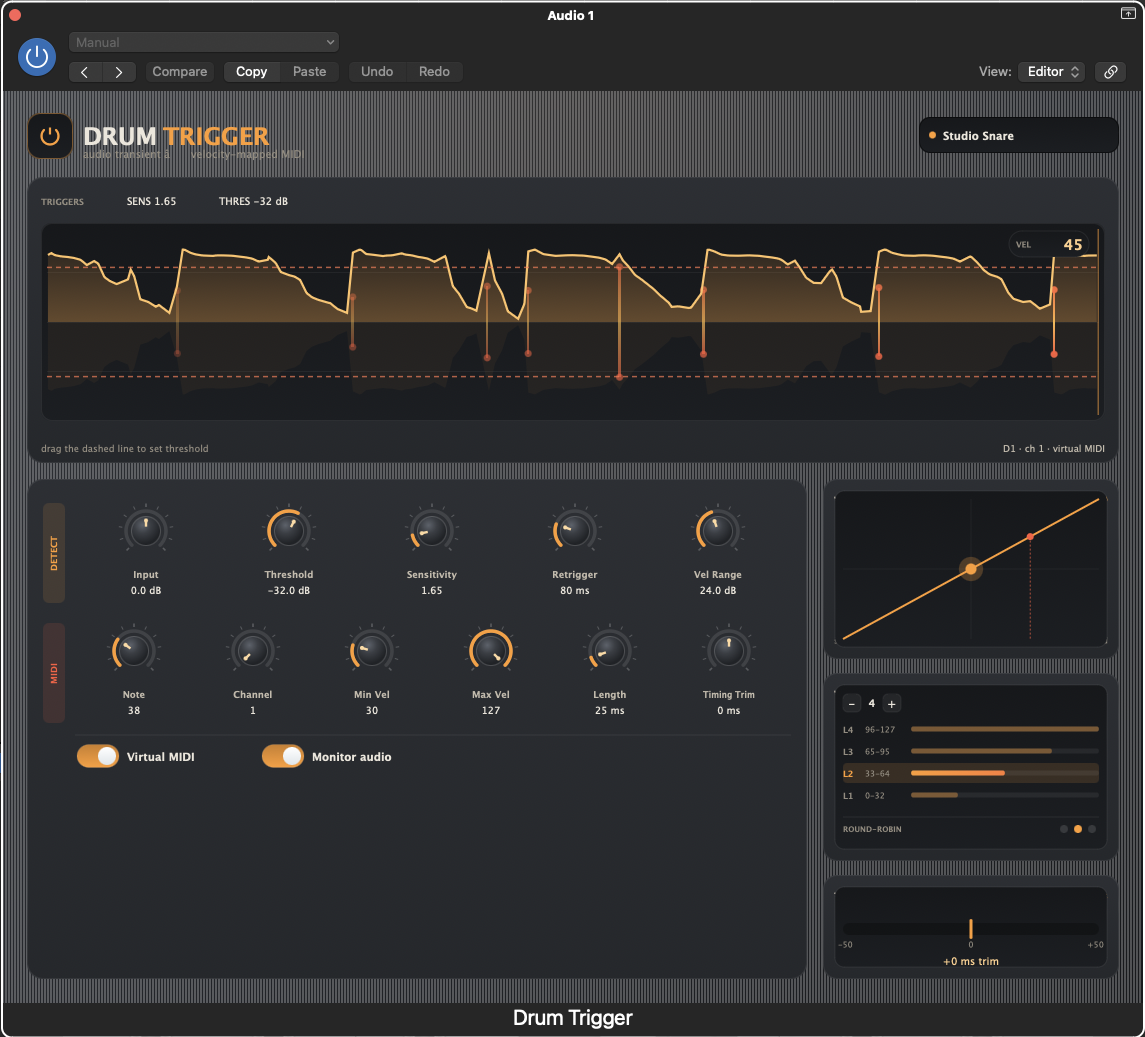
Drum Trigger plugin interface
01 / Workflow

Three steps. One drum track.

Drum Trigger is built around the simplest possible flow — drop it on the track, dial in the detector, route the MIDI. Everything in the editor maps to those three steps, and the live trigger view shows exactly what's being detected as you play.

Step · Insert

On the drum track

Load Drum Trigger on any track carrying a single drum element — a kick mic, a snare top, a tom close mic, a closed hat. One instance per hit type keeps detection focused and tight.

Step · Detect

Dial it in by ear

Watch the live trigger view as the track plays. Threshold sets the floor; Sensitivity tunes how hard a peak has to be; Retrigger blocks doubles for a configurable window. Aim for one orange marker per real hit.

Step · Trigger

Route the MIDI

Pick a MIDI note, a channel, and a velocity range. Send to a virtual MIDI port for hardware, an instrument plugin on the next track, or DDM S1 sitting alongside in the same session.

02 / Detection

Transient first. Then envelope. Then MIDI.

The detector watches the input envelope for sudden rises above your Threshold. Sensitivity scales how sharply a peak has to climb to count as a hit. The Retrigger lockout blocks doubles. Velocity is mapped from the peak height against your Vel Range — so a soft ghost note and a backbeat smack come out at the right MIDI velocities.

Input envelope Detected trigger · MIDI hit Threshold
03 / Controls

Ten knobs, two toggles. No menus.

Detect

The transient detector
  • InputPre-detector gain trim. Compensate hot or quiet stems.−24 — +24 dB
  • ThresholdLevel the input envelope must cross to count as a hit.−60 — 0 dB
  • SensitivityHow sharply a peak must climb. Higher = stricter.0.50 — 4.00
  • RetriggerLockout window after each hit. Blocks doubles.10 — 500 ms
  • Vel RangePeak-height window mapped to MIDI 0–127.6 — 36 dB

MIDI

What gets sent
  • MIDI NoteNote number sent per hit. GM kick = 36, snare = 38.0 — 127
  • ChannelOutput MIDI channel.1 — 16
  • Min VelVelocity floor. Hits softer than this are clamped here.0 — 127
  • Max VelVelocity ceiling. Caps how hard a hit can land.0 — 127
  • LengthNote-on to note-off interval. Short for drums.5 — 500 ms

Virtual MIDI

Toggle · top-right

Send MIDI to a virtual port so hardware modules or other apps can receive triggers. Off keeps MIDI inside the host only — useful when you're routing to an instrument plugin on the next track.

Monitor audio

Toggle · top-right

Pass the original audio through alongside the MIDI output, or mute it so only the triggered instrument is audible. Useful for A/B comparison between the source kit and the replaced sound.

04 / Features

Clean triggering. Real dynamics.

F.01

Turns recorded drum hits into MIDI

A focused single-channel transient detector. One kick mic in, one MIDI stream out. The Triggers display in the editor draws the envelope in blue and stamps each detected hit with an orange marker so you can validate every trigger by eye in real time.

Transient detector · Live trigger view
F.02

Velocity that tracks the performance

Each hit's peak height is mapped against the configurable Vel Range and clamped to your Min/Max Velocity — so a softly brushed ghost note and a hard backbeat smack come out at different MIDI velocities. The replacement sample breathes with the player, not against them.

Peak-tracked velocity · Min/Max clamp
F.03

Per-track MIDI note and channel

Assign each instance a MIDI note (GM-standard kick = 36, snare = 38, hat = 42) and a channel. Stack three instances on three drum mics, send them all to channel 10 with different notes, and feed a sampler that hears all three at once.

Per-instance note + channel · GM-compatible
F.04

Virtual MIDI for hardware routing

Toggle Virtual MIDI on and the plugin advertises a CoreMIDI port. Any hardware sampler, drum module, or external app receives the triggers in real time. Off keeps the MIDI inside the DAW for plugin-to-plugin chains.

CoreMIDI virtual port · DAW-internal mode
F.05

Audio pass-through or muted output

Monitor audio sends the original drum signal through alongside the MIDI — useful for parallel layering. Disable it and only the triggered instrument sounds — useful when you're fully replacing the kit element with a sample.

Pass-through · Mute for replacement
F.06

Tightens drums without erasing the groove

Because the velocity tracks the original performance, the replaced kit stays human. The detector preserves the timing of every hit — including the small drag and push that make a real kit feel alive — and lets you swap the sound underneath without touching the feel.

Groove-preserving · Sample-replacement
05 / Where it fits

Three workflows that save the take.

Sample replacement

Tracking / mixing

A great take with a so-so kick. Drop Drum Trigger on the kick mic, route the MIDI to a sampler with the kick sound you actually wanted, mute the original. The performance lands intact, the sound is new.

Layering and reinforcement

Mixing

Keep the original snare audible (Monitor audio on) and route the MIDI to a sample layer underneath. Use the original's transient for attack and a tuned sample for body. The composite is bigger than either alone.

Drive hardware from a take

Tracking / sound design

Virtual MIDI on. The drummer plays an acoustic kit; the triggers fire a hardware sampler in real time. Useful for hybrid kits, electronic-percussion stacks, or feeding a drum module that lives outside the DAW.

06 / Pairs with DDM S1

A trigger only matters if what it triggers feels real.

Drum Trigger sends one MIDI hit per drum strike with a velocity that tracks the original performance. Feed those triggers into DDM S1's drum engine — each pad can hold up to eight velocity-layered samples with smooth equal-power crossfades — and the replacement kit responds the way a real drum does. Soft ghost notes get the soft sample. Backbeats get the hard one. Nothing flattens; nothing sounds robotic.

DDM S1 · 8-layer drum engine

Real performance in, real velocity out.

Drum Trigger reads each hit's peak energy and stamps it into MIDI velocity. DDM S1's drum engine reads that velocity and picks the right sample from up to eight zones — crossfading adjacent layers across a ±0.05 equal-power window so transitions disappear into the playing.

The result is a replaced kit that breathes with the player. No machine-gun stepping between zones. No flat single-sample feel. Drop Drum Trigger on the kick mic, route the MIDI to a DDM S1 pad loaded with 8 layers, and the song's groove stays intact while the sound becomes whatever you want it to be.

See DDM S1 →
One trigger · eight layers · the right sample, every hit
07 / At a glance

The numbers that matter.

10
Controls · 5 Detect · 5 MIDI
2
Toggles · Virtual MIDI · Monitor
1 hit/inst
Per-track focused detection
127
Velocity resolution · MIDI standard
CoreMIDI
Virtual port output
AU
Plugin format · Standalone too
0 menus
Everything on one panel
Live
Trigger visualizer · real-time
08 / More from DreamLab

The rest of the rack.

Dynamics

Multiband

Phase-coherent 4-band mastering compressor with interactive spectrum and A/B peak-hold.

Equalizer

Muse EQ

AI-assisted equalizer · 9 analog voicings per band · Gemma 4 local inference.

Synthesizer

DDM S1

64-voice hybrid subtractive + 6-op FM polysynth with 8 algorithms.

Reverb

Convolution Reverb

Multi-engine reverb: a true-stereo convolver plus six algorithms, with shimmer, freeze, duck, and delay-into-reverb.

Saturation

SAT 456

Physically-modeled tape saturation — harmonic warmth, transient punch, smooth top end, and wow/flutter motion from a single insert.

Synthesizer

Synth CH388

Six-voice virtual analogue polysynth — rock-stable oscillator, creamy four-pole filter, and a two-mode stereo chorus. Zero latency, one panel.

Spatializer

Binaural Panner

3D placement panner with crosstalk cancellation. Works on headphones and real stereo monitors.

Restoration

Adaptive Noise Reducer

Real-time spectral suppression + envelope gate. Dual-stage attenuation with live activity meters.

Networking · free

AudioOverNetwork

AES67 / ST 2110 audio-over-IP between DAWs. Sub-5 ms on gigabit. MIT-licensed, open source.

Spectral filter

Sound Morph

Morphing spectral filter · 5 anchor shapes · dual-LFO motion · studio shimmer.

Modulation

D Chorus

Stereo BBD chorus and pitch shifter. Wide, warm, and wild. AU · VST3.

Metering

LUFS Master

BS.1770-4 loudness metering, phase scope, and a true-peak brickwall limiter. AU · VST3 · Standalone.

Pitch

Pitch Corrector

Real-time pitch correction — natural intonation to hard-tune, with formant preservation. AU · VST3 · Standalone.

Modulation

DuoPhase

Dual 6-stage optical phaser with two sweep generators. Deep series swirls or wide parallel stereo motion.

Synthesizer

Vorion

Three oscillators, eight voices, and a modulation matrix built for trouble.

Overdrive

ScreamDriver

Circuit-modelled three-stage overdrive with tube-style compression, tape saturation, BBD chorus, pitch-bending echo, spring tank and a zero-latency cabinet loader.

Granular atmosphere

Lush

A granular atmosphere engine — Drone, Reverse, Shimmer and Gliss modes, pitch-tracked grains, and a Freeze that holds a cloud indefinitely.

Rhythm composer

DreamLab Drum Machine

Sixteen voices on a step sequencer that works the way the originals did — per-voice tune, decay and filter, accent per step, and producer-style swing.

Neural amplifier

Zelos

Neural amp capture and playback. Load a model or capture your own rig. Free · public beta.

Lo-fi

DreamLab Lo-Fi

Seven lo-fi modules on one panel — saturation, wow and flutter, bit crush, band limiting, dropouts, ambience and a ducked noise bed, under one Amount macro.

Delay

DreamLab Delay

Stereo analog echo and ducking delay — tape and lo-fi character, repeat filtering, ping-pong, and program-dependent ducking.

Currently viewing

Drum Trigger

Audio transient to MIDI generator. Tighten drums without losing groove. AU · Standalone.

Companion tool

Impulse Lab

Build your own impulse responses — design a space or capture a real one, deconvolve, and load it straight into Verb.

MIDI generator · free

Vibe Generator

A MIDI plug-in that writes full ambient, neo-soul and lo-fi songs across five parts. Free · public beta.

FORMATS
AU · VST3
ARCHITECTURE
Universal — Apple Silicon and IntelAPPLE M-SERIES RECOMMENDED
SECURITY
Signed and notarised by Apple
REQUIRES
macOS 10.13

Drum Trigger is an original Dreamlab Digital Media product. It is not affiliated with, endorsed by, or derived from any hardware or software manufacturer. Full licence terms at dreamlabnet.com/daw2/eula.html.